


Oct 16, 2025 Updated 1z0-1104-25 Dumps Questions For Oracle Exam
Best Value Available Preparation Guide for 1z0-1104-25 Exam
NEW QUESTION # 23
Task 4: Create a Certificate Authority (CA)
Create a certificate authority, where:
CA name: PBT-CERT-CA-01-<username>
For example, if your username is 99008677-lab.user01, then the certificate authority name should be PBT- CERT-CA-01990086771abuser01 Ensure you eliminate special characters from the user name.
Common name: PBT-CERT-OCICA-01
Master Encryption Key: PBT-CERT-MEK-01 (created in the previous task)
Answer:
Explanation:
See the solution below in Explanation.
Task 4: Create a Certificate Authority (CA)
Step 1: Access the OCI Vault
* Log in to the OCI Console.
* Navigate toIdentity & Security>Vault.
* Select the root compartment.
* Locate and click on the vault named PBI_Vault_SP.
Step 2: Create the Certificate Authority
* In the PBI_Vault_SP vault details page, underResources, clickCertificate Authorities.
* ClickCreate Certificate Authority.
* Enter the following details:
* Name: Replace <username> with your username (e.g., if your username is 99008677-lab.user01, remove special characters like - and . to get 99008677labuser01, then use PBT-CERT-CA-
0199008677labuser01).
* Common Name: Enter PBT-CERT-OCICA-01.
* Master Encryption Key: Select the PBT-CERT-MEK-01<username> key created in Task 3 (e.
g., PBT-CERT-MEK-0199008677labuser01).
* Subject: Leave as default or adjust (e.g., Organization, Country) if required by your setup.
* Validity Period: Set as needed (e.g., 10 years), or use the default.
* Compartment: Ensure it's set to the root compartment.
* ClickCreate Certificate Authorityand wait for the CA to be provisioned.
Step 3: Verify the Certificate Authority
* After creation, go to theCertificate Authoritiessection under PBI_Vault_SP.
* Confirm the CA PBT-CERT-CA-01<username> (e.g., PBT-CERT-CA-0199008677labuser01) is listed and its status is active.
NEW QUESTION # 24
Task 7: Verify the OCI Certificate with Load Balancer
Verify HTTPS connection to the load balancer by running the following command in Cloud Shell curl -k https://<Public IP of PBT-CERT-LB-01> Enter the following URL in the web browser:
https://<Public IP of PBT-CERT-LB-01>
If prompted with a certificate error, accept the risk and continue.
Verify web page content by ensuring the text, "You are visiting Web Server 1" from the index.html file is displayed in the browser See the solution below in Explanation.
Answer:
Explanation:
Task 7: Verify the OCI Certificate with Load Balancer
Step 1: Obtain the Public IP of the Load Balancer
* Log in to the OCI Console.
* Navigate toNetworking>Load Balancers.
* Click on PBT-CERT-LB-01.
* Note thePublic IP Addressfrom the load balancer details page.
Step 2: Verify HTTPS Connection Using Cloud Shell
* Open the OCI Cloud Shell from the top-right corner of the OCI Console.
* Run the following command, replacing <Public IP of PBT-CERT-LB-01> with the public IP you noted:
curl -k https://<Public IP of PBT-CERT-LB-01>
* Expected output: You should see the text "You are visiting Web Server 1" if the connection is successful. The -k flag ignores certificate validation errors (common during initial testing with self- signed or newly issued certificates).
* If you encounter an error, ensure the load balancer is active, the listener is configured correctly, and the backend server (PBT-CERT-VM-01) is reachable.
Step 3: Verify in a Web Browser
* Open a web browser.
* Enter the following URL, replacing <Public IP of PBT-CERT-LB-01> with the public IP you noted:
https://<Public IP of PBT-CERT-LB-01>
* If prompted with a certificate warning (e.g., due to a self-signed certificate or untrusted CA), accept the risk and proceed (click "Advanced" and "Proceed" or similar, depending on your browser).
* Verify that the web page displays the text "You are visiting Web Server 1" from the index.html file created on PBT-CERT-VM-01.
Step 4: Troubleshoot (if needed)
* If the text is not displayed:
* Check the load balancer health status underBackend Sets>Healthin the OCI Console.
* Ensure the security list PBT-CERT-LB-SL-01 allows port 443 and the compute instance security list allows port 80.
* Verify the Apache service is running on PBT-CERT-VM-01 by SSHing in and running sudo systemctl status httpd.
NEW QUESTION # 25
An E-commerce company running on Oracle Cloud Infrastructure (OCI) wants to prevent accidental misconfigurations that could expose sensitive data. They need an OCI service that can enforce predefined security rules when creating or modifying cloud resources.
Which OCI service should they use?
- A. OCI Certificates
- B. OCI Security Zone
- C. OCI Web Application Firewall (WAF)
- D. OCI Identity and Access Management (IAM)
Answer: B
NEW QUESTION # 26
A company has implemented OCI IAM policies with multiple levels of compartments. A policy attached to a parent compartment grants "manage virtual-network-family" permissions. A policy attached to a child compartment grants "use virtual-network-family" permissions.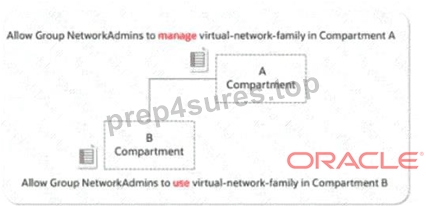
According to OCI IAM policy inheritance, how does the OCI IAM policy engine resolve the permissions for a user attempting to perform an operation that requires 'manage' permissions in the child compartment?
- A. The policy in the child compartment takes precedence, and the user is granted "use" permissions only.
- B. The policy in the parent compartment takes precedence, and the user is granted "manage" permissions.
- C. The operation is denied due to conflicting policies.
Answer: B
NEW QUESTION # 27
You have created a compartment TEST in your subscribed tenancy. Then, you created two groups, test1 and test2, and want the users in these groups to be able to manage all the resources in the TEST compartment.
Which policy would you use to achieve this?
- A. Allow group test1, test2 to manage all resources in compartment test.
- B. Allow any-user to manage all resources in compartment test where any {request.groups.test1, test2}
- C. Allow any-user to manage all resources in compartment test where request.group='test*'
- D. Allow group/test*/to manage all resources in compartment test.
Answer: A
NEW QUESTION # 28
Challenge 2 -Task 1
In deploying a new application, a cloud customer needs to reflect different security postures. If a security zone is enabled with the Maximum Security Zone recipe, the customer will be unable to create or update a resource in the security zone if the action violates the attached Maximum Security Zone policy.
As an application requirement, the customer requires a compute instance in the public subnet. You therefore, need to configure Custom Security Zones that allow the creation of compute instances in the public subnet.
Review the architecture diagram, which outlines the resoures you'll need to address the requirement: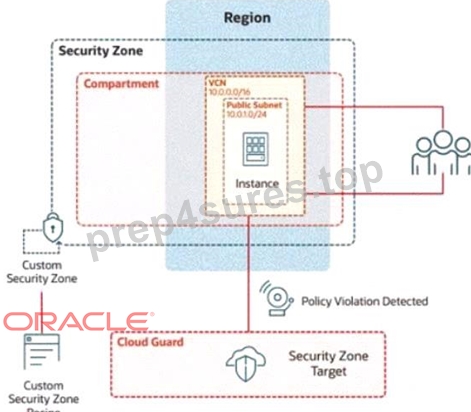
Preconfigured
To complete this requirement, you are provided with the following:
Access to an OCI tenancy, an assigned compartment, and OCI credentials
Required IAM policies
Task 4: Create a Public Subnet
Create a public subnet named IAD-SP-PBT-PUBSNET-01, within the VCN IAD-SP-PBT-VCN-01 use a CIDR block of 10.0.1.0/24 and configure the subnet to use the internet Gateway See the solution below in Explanation.
Answer:
Explanation:
To create a public subnet named IAD-SP-PBT-PUBSNET-01 within the VCN IAD-SP-PBT-VCN-01 using a CIDR block of 10.0.1.0/24 and configure it to use the Internet Gateway, follow these steps based on the Oracle Cloud Infrastructure (OCI) Networking documentation.
Step-by-Step Solution for Task 4: Create a Public Subnet
* Log in to the OCI Console:
* Use your OCI credentials to log in to the OCI Console (https://console.us-ashburn-1.oraclecloud.
com).
* Ensure you have access to the assigned compartment.
* Navigate to Virtual Cloud Networks:
* From the OCI Console, click the navigation menu (hamburger icon) on the top left.
* UnderNetworking, selectVirtual Cloud Networks.
* Select the VCN:
* Locate and click on the VCN named IAD-SP-PBT-VCN-01 created in Task 3.
* UnderResources, selectSubnets.
* Create a New Subnet:
* Click theCreate Subnetbutton.
* Configure the Subnet Details:
* Name:Enter IAD-SP-PBT-PUBSNET-01.
* Compartment:Ensure it is set to the assigned compartment.
* Subnet Type:SelectPublic Subnet.
* CIDR Block:Enter 10.0.1.0/24.
* Route Table:Select the default route table associated with the VCN (ensure it includes a route to the Internet Gateway with destination 0.0.0.0/0).
* Subnet Access:SelectPublic Subnetand ensure the Internet Gateway is associated.
* DHCP Options:Leave as default or customize if required.
* Security List:Use the default security list or create a new one with appropriate ingress/egress rules (e.g., allow TCP port 22 for SSH and all egress traffic).
* Associate the Internet Gateway:
* Verify that the subnet is configured to route traffic through the Internet Gateway. This is automatically handled if you selected the public subnet option and the VCN's route table is correctly set (as configured in Task 3).
* If needed, edit the route table for the subnet to ensure a rule exists:
* Destination CIDR Block:0.0.0.0/0
* Target Type:Internet Gateway
* Target:Select the Internet Gateway associated with IAD-SP-PBT-VCN-01.
* Create the Subnet:
* ClickCreateto provision the subnet.
* Once created, the subnet will be listed under the VCN's subnets.
* Verify the Configuration:
* Go to the subnet details page for IAD-SP-PBT-PUBSNET-01.
* Confirm the CIDR block is 10.0.1.0/24 and that it is a public subnet with Internet Gateway access.
Notes
* Ensure the CIDR block 10.0.1.0/24 does not overlap with existing subnets in the VCN (10.0.0.0/16, including 10.0.10.0/24 from Task 3).
* The Internet Gateway association relies on the route table configuration from Task 3. If it's missing, update the route table as described in Step 6.
NEW QUESTION # 29
You are the first responder of a security incident for ABC Org. You have identified several IP addresses and URLs in the logs that you suspect may be related to the incident. However, you need more information to confidently determine whether they are indeed malicious or not.
Which OCI service can you use to obtain a more refined information and confidence score for these identified indicators?
- A. OCI Security Zones
- B. OCI Threat Intelligence
- C. OCI Incidence Responder
- D. OCI Web Application Firewall
Answer: B
NEW QUESTION # 30
Challenge 2
In deploying a new application, a cloud customer needs to reflect different security postures. If a security zone is enabled with the Maximum Security Zone recipe, the customer will be unable to create or update a resource in the security zone if the action violates the attached Maximum Security Zone policy.
As an application requirement, the customer requires a compute instance in the public subnet. You therefore, need to configure Custom Security Zones that allow the creation of compute instances in the public subnet.
Review the architecture diagram, which outlines the resoures you'll need to address the requirement:
Preconfigured
To complete this requirement, you are provided with the following:
Access to an OCI tenancy, an assigned compartment, and OCI credentials
Required IAM policies
Task 5: Provision a Compute Instance
Provision a compute instance in the IAD-SP-PBT-PUBSNET-01 public subnet, where:
Name IAD-SP-PBT-1-VM-01
image: Oracle Linux 8
Shape VM: Standard, A1, Flex
Enter the OCID of the created compute instance in the text box below.
Answer:
Explanation:
See the solution below in Explanation.
Explanation:
To provision a compute instance named IAD-SP-PBT-1-VM-01 in the IAD-SP-PBT-PUBSNET-01 public subnet with the specified configuration (Oracle Linux 8 image, VM Standard A1 Flex shape), follow these steps based on the Oracle Cloud Infrastructure (OCI) Compute documentation.
Step-by-Step Solution for Task 5: Provision a Compute Instance
* Log in to the OCI Console:
* Use your OCI credentials to log in to the OCI Console (https://console.us-ashburn-1.oraclecloud.
com).
* Ensure you have access to the assigned compartment.
* Navigate to Compute Instances:
* From the OCI Console, click the navigation menu (hamburger icon) on the top left.
* UnderCompute, selectInstances.
* Create a New Compute Instance:
* Click theCreate Instancebutton.
* Configure the Instance Details:
* Name:Enter IAD-SP-PBT-1-VM-01.
* Compartment:Select the assigned compartment.
* Placement:Choose the availability domain (e.g., AD-1) based on your region's availability.
* Select the Image:
* UnderImage and Shape, clickChange Image.
* SelectOracle Linux 8from the platform images list.
* ClickSelect Image.
* Choose the Shape:
* ClickChange Shape.
* SelectVM Standardcategory.
* ChooseA1 Flexfrom the shape options.
* Configure the OCPUs (e.g., 1 OCPU) and memory (e.g., 6 GB) as needed for A1 Flex, then click Select Shape.
* Configure Networking:
* UnderNetworking, ensure theVirtual Cloud Networkis set to IAD-SP-PBT-VCN-01.
* Set theSubnetto IAD-SP-PBT-PUBSNET-01 (public subnet with CIDR 10.0.1.0/24).
* EnableAssign a public IPv4 addressto allow external connectivity.
* Leave the default security list or assign a custom one if configured previously.
* Set Up SSH Access:
* UnderAdd SSH Keys, either:
* Upload your public SSH key file, or
* Paste your public SSH key manually.
* This ensures you can access the instance via SSH.
* Launch the Instance:
* ClickCreateto provision the compute instance.
* Wait for the instance to reach theRunningstate (this may take a few minutes).
* Note the Instance OCID:
* Once the instance is running, go to the instance details page for IAD-SP-PBT-1-VM-01.
* Copy theOCIDdisplayed (e.g., ocid1.instance.oc1..<unique_string>).
OCID of the Created Compute Instance
* Enter the OCID of the created compute instance (IAD-SP-PBT-1-VM-01) into the text box. The exact OCID will be available after Step 9 (e.g., ocid1.instance.oc1..<unique_string>).
Notes
* Ensure the security zone IAD_SAP-PBT-CSZ-01 and its associated recipe IAD-SP-PBT-CSP-01 allow compute instance creation in the public subnet (10.0.1.0/24).
* Verify network connectivity by testing SSH access using the public IP assigned to the instance.
NEW QUESTION # 31
Within OCI IAM identity domains, the AD Bridge component serves a critical role. How does the AD Bridge functionality specifically enhance Identity and Access Management (IAM) practices?
- A. It directly integrates with OCI MFA providers, allowing for seamless enforcement of MFA for users authenticated through AD credentials.
- B. It facilitates delegated administration, allowing authorized AD users to manage specific resources within the OCI identity domain.
- C. It simplifies user provisioning by enabling automated synchronization of user accounts and group memberships from an existing Microsoft Active Directory (AD) environment.
- D. It strengthens access security by providing an additional layer of authentication through AD integration.
Answer: C
NEW QUESTION # 32
"A business has a hybrid cloud infrastructure with Oracle Linux instances running in OCI and on-premises.
They want to reduce the amount of bandwidth used when patching systems.
Which component of OS Management Hub can help to reduce the bandwidth usage for patching?
- A. Management agents
- B. Profiles"
- C. Management stations
- D. Dynamic groups
Answer: B
NEW QUESTION # 33
"Your company is building a highly available and secure web application on OCI. Because of increasing malicious web-based attacks, the security team has mandated that web servers should not be exposed directly to the Internet.
How should you architect the solution while ensuring fault tolerance and security?
- A. Deploy at least three web servers in different fault domains within a public subnet. Use OCI Traffic Management service for DNS-based load balancing."
- B. Deploy at least three web servers in different fault domains within a private subnet. Place a public load balancer in a public subnet, but skip WAF configuration.
- C. Deploy at least three web servers in different fault domains within a public subnet, each with a public IP address. Deploy Web Application Firewall (WAF), and configure an origin for each public IP.
- D. Deploy at least three web servers in different fault domains within a private subnet. Place a public load balancer in a public subnet and configure a back-end set for all web servers. Deploy Web Application Firewall (WAF) and set the load balancer public IP address as the origin.
Answer: D
NEW QUESTION # 34
Challenge 2 -Task 1
In deploying a new application, a cloud customer needs to reflect different security postures. If a security zone is enabled with the Maximum Security Zone recipe, the customer will be unable to create or update a resource in the security zone if the action violates the attached Maximum Security Zone policy.
As an application requirement, the customer requires a compute instance in the public subnet. You therefore, need to configure Custom Security Zones that allow the creation of compute instances in the public subnet.
Review the architecture diagram, which outlines the resoures you'll need to address the requirement:
Preconfigured
To complete this requirement, you are provided with the following:
Access to an OCI tenancy, an assigned compartment, and OCI credentials
Required IAM policies
Task 1: Create a Custom Security Zone Recipe
Create a Custom Security Zone Recipe named IAD-SP-PBT-CSP-01 that allows the provisioning of compute instances in the public subnet.
Enter the OCID of the created custom security zone recipe in the text box below.
Answer:
Explanation:
See the solution below in Explanation.
Explanation:
To create a Custom Security Zone Recipe named IAD-SP-PBT-CSP-01 that allows the provisioning of compute instances in a public subnet, we will follow the steps outlined in the Oracle Cloud Infrastructure (OCI) Security Zones documentation. These steps are based on verified procedures from the OCI Security Zone Guide and related resources.
Step-by-Step Solution for Task 1: Create a Custom Security Zone Recipe
* Log in to the OCI Console:
* Use your OCI credentials to log in to the OCI Console (https://console.us-ashburn-1.oraclecloud.
com).
* Ensure you have access to the assigned compartment provided in the tenancy.
* Navigate to Security Zones:
* From the OCI Console, go to the navigation menu (hamburger icon) on the top left.
* UnderGovernance and Administration, selectSecurity Zones.
* Create a New Security Zone Recipe:
* In the Security Zones dashboard, click on theRecipestab.
* Click theCreate Recipebutton.
* Configure the Recipe Details:
* Name:Enter IAD-SP-PBT-CSP-01.
* Description:(Optional) Add a description, e.g., "Custom recipe to allow compute instances in public subnet."
* Leave theCompartmentas the assigned compartment provided.
* Define the Security Zone Policy:
* In the policy editor, start with a base policy. Since the Maximum Security Zone recipe restricts public subnet usage, you need to customize it.
* Add the following policy statement to allow compute instances in a public subnet:
Allow service compute to use virtual-network-family in compartment <compartment-name> where ALL { target.resource.type = 'Instance', target.vcn.cidr_block = '10.0.0.0/16', target.subnet.cidr_block = '10.0.10.0/24'
}
* Replace <compartment-name> with the name of your assigned compartment.
* This policy allows the Compute service to provision instances in the public subnet (10.0.10.0/24) within the VCN (10.0.0.0/16).
* Adjust Restrictions:
* Ensure the recipe does not inherit the Maximum Security Zone recipe's default restrictions that block public subnet usage. Explicitly allow the public subnet by including the subnet CIDR block (10.0.10.0/24) in the policy.
* Remove or modify any conflicting default rules that prohibit public subnet usage (e.g., rules blocking internet access or public IP assignment).
* Save the Recipe:
* ClickCreateto save the custom security zone recipe.
* Once created, note theOCIDof the recipe from the recipe details page. The OCID will be a unique identifier starting with ocid1.securityzonerecipe.
* Verify the Recipe:
* Go to theRecipestab and locate IAD-SP-PBT-CSP-01.
* Ensure the policy reflects the allowance for compute instances in the public subnet by reviewing the policy statement.
OCID of the Created Custom Security Zone Recipe
* The exact OCID will be generated upon creation (e.g., ocid1.securityzonerecipe.oc1..unique_string).
Please enter the OCID displayed in the OCI Console after completing Step 7.
Notes
* Ensure IAM policies are correctly configured to grant you permissions to create and manage security zone recipes in the compartment.
* The policy assumes the public subnet CIDR (10.0.10.0/24) matches the diagram. Adjust if the actual subnet CIDR differs.
* Test the recipe by associating it with a security zone and attempting to launch a compute instance to confirm compliance.
NEW QUESTION # 35
Task 6: Create Load Balancer and Attach Certificate
Create a Load Balancer with the name PBT-CERT-LB-01 in subnet LB-Subnet-PBT-CERT-SNET-02 Create a Listener for the load balancer, where:
Name: PBT-CERT-LB_LTSN_01
Protocol: HTTPS
Port: 443
Attach the certificate PBT-CERT-01-<username> to the load balancer
Attach the security list PBT-CERT-LB-SL-01 to subnet LB-Subnet-PBT-CERT-SNET-02 See the solution below in Explanation.
Answer:
Explanation:
Task 6: Create Load Balancer and Attach Certificate
Step 1: Create the Load Balancer
* Log in to the OCI Console.
* Navigate toNetworking>Load Balancers.
* ClickCreate Load Balancer.
* Enter the following details:
* Name: PBT-CERT-LB-01
* Compartment: Select your assigned compartment.
* Load Balancer Type: SelectPublic.
* Virtual Cloud Network: Select PBT-CERT-VCN-01.
* Subnet: Select LB-Subnet-PBT-CERT-SNET-02.
* Shape: Choose a shape (e.g., 10 Mbps, adjust based on needs).
* ClickNext.
* Leave backend sets and listeners as default for now (we'll configure the listener next).
* ClickCreate Load Balancerand wait for it to be provisioned.
Step 2: Create a Listener
* Once the load balancer is created, go to theLoad Balancerspage and click on PBT-CERT-LB-01.
* UnderResources, clickListeners.
* ClickCreate Listener.
* Enter the following details:
* Name: PBT-CERT-LB_LTSN_01
* Protocol: SelectHTTPS.
* Port: Enter 443.
* Certificate: ClickAdd Certificate, then select the PBT-CERT-01<username> certificate (e.g., PBT-CERT-0199008677labuser01) created in Task 5.
* Leave other settings (e.g., SSL handling) as default unless specified.
* ClickCreate.
Step 3: Configure the Backend Set
* In the PBT-CERT-LB-01 details page, underResources, clickBackend Sets.
* ClickCreate Backend Set(if not already created).
* Enter basic details (e.g., name like PBT-CERT-BS-01).
* Add a backend server:
* IP Address: Use the private IP of PBT-CERT-VM-01 (find this in the instance details under Compute>Instances).
* Port: 80 (HTTP, as configured on the web server).
* Protocol: HTTP.
* ClickCreate.
Step 4: Attach the Security List to the Subnet
* Navigate toNetworking>Virtual Cloud Networks.
* Select PBT-CERT-VCN-01 and clickSubnets.
* Click on LB-Subnet-PBT-CERT-SNET-02.
* UnderSecurity Lists, ensure PBT-CERT-LB-SL-01 is attached. If not:
* ClickEdit.
* Remove the default security list and add PBT-CERT-LB-SL-01.
* ClickSave Changes.
Step 5: Verify the Configuration
* Ensure the load balancer health status is OK (check underBackend Sets>Health).
* Test by accessing https://<load-balancer-public-ip> in a browser (replace with the public IP from the load balancer details).
NEW QUESTION # 36
In Oracle Cloud Infrastructure (OCI), bare metal instances provide customers with direct access to the underlying hardware. To mitigate security risks when a customer terminates a bare metal instance, OCI utilizes Root-of-Trust hardware.
What is the primary function of the Root-of-Trust hardware in this context?
- A. It ensures all non-volatile memory on the terminated instance is securely wiped before reuse.
- B. It guarantees complete isolation between customer workloads on different instances.
- C. It automatically encrypts data at rest on the bare metal instance.
- D. It eliminates the need for hypervisors, reducing the potential attack surface.
Answer: A
NEW QUESTION # 37
A company has deployed OCI Zero Trust Packet Routing (ZPR) to secure its network. They have two compute instances, VM1-01 and VM-02, in a public subnet. VM-01 is tagged with the security attribute app:
vm01, and VM-02 is tagged with app:vm02. The VCN is labeled with network:vcn01, The ZPR policy states:
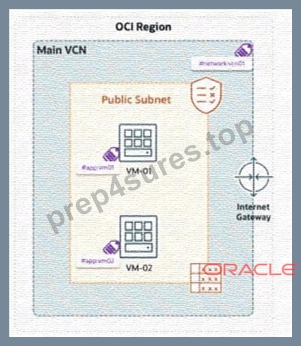
"What is the expected outcome of this policy?
- A. Both VM-01 and VM-02 can SSH into each other.
- B. Neither VM-01 nor VM-02 can SSH into each other."
- C. VM-02 can SSH into VM-01, but VM-01 cannot SSH into VM-02.
- D. VM-01 can SSH into VM-02, but VM-02 cannot SSH into VM-01.
Answer: D
NEW QUESTION # 38
......
Oracle 1z0-1104-25 Exam Syllabus Topics:
| Topic | Details |
|---|---|
| Topic 1 |
|
| Topic 2 |
|
| Topic 3 |
|
| Topic 4 |
|
Full 1z0-1104-25 Practice Test and 39 Unique Questions, Get it Now!: https://www.prep4sures.top/1z0-1104-25-exam-dumps-torrent.html
The Best 1z0-1104-25 Exam Study Material Premium Files and Preparation Tool: https://drive.google.com/open?id=1eCOqiZCZwHa5DiKK-lEZsvMgZCOrZRjZ