


(2024) PASS Databricks-Machine-Learning-Professional exam with Databricks Databricks-Machine-Learning-Professional Real Exam Questions
Real exam questions are provided for ML Data Scientist tests, which can make sure you 100% pass
Databricks Databricks-Machine-Learning-Professional Exam Syllabus Topics:
| Topic | Details |
|---|---|
| Topic 1 |
|
| Topic 2 |
|
| Topic 3 |
|
| Topic 4 |
|
| Topic 5 |
|
| Topic 6 |
|
| Topic 7 |
|
| Topic 8 |
|
| Topic 9 |
|
| Topic 10 |
|
NEW QUESTION # 21
Which of the following describes the purpose of the context parameter in the predict method of Python models for MLflow?
- A. The context parameter allows the user to document the performance of a model after it has been deployed
- B. The context parameter allows the user to specify which version of the registered MLflow Model should be used based on the given application's current scenario
- C. The context parameter allows the user to include relevant details of the business case to allow downstream users to understand the purpose of the model
- D. The context parameter allows the user to provide the model access to objects like preprocessing models or custom configuration files
- E. The context parameter allows the user to provide the model with completely custom if-else logic for the given application's current scenario
Answer: B
NEW QUESTION # 22
In a continuous integration, continuous deployment (CI/CD) process for machine learning pipelines, which of the following events commonly triggers the execution of automated testing?
- A. The launch of a new cost-efficient SQL endpoint
- B. The arrival of a new model version in the MLflow Model Registry
- C. The arrival of a new feature table in the Feature Store
- D. CI/CD pipelines are not needed for machine learning pipelines
- E. The launch of a new cost-efficient job cluster
Answer: E
NEW QUESTION # 23
A data scientist has developed a model model and computed the RMSE of the model on the test set. They have assigned this value to the variable rmse. They now want to manually store the RMSE value with the MLflow run.
They write the following incomplete code block:
Which of the following lines of code can be used to fill in the blank so the code block can successfully complete the task?
- A. log_metric
- B. log_model
- C. log_artifact
- D. log_param
- E. There is no way to store values like this.
Answer: C
NEW QUESTION # 24
A machine learning engineer is migrating a machine learning pipeline to use Databricks Machine Learning. They have programmatically identified the best run from an MLflow Experiment and stored its URI in the model_uri variable and its Run ID in the run_id variable. They have also determined that the model was logged with the name "model". Now, the machine learning engineer wants to register that model in the MLflow Model Registry with the name "best_model".
Which of the following lines of code can they use to register the model to the MLflow Model Registry?
- A. mlflow.register_model(f"runs:/{run_id}/best_model", "model")
- B. mlflow.register_model(model_uri, "best_model")
- C. mlflow.register_model(f"runs:/{run_id}/model")
- D. mlflow.register_model(run_id, "best_model")
- E. mlflow.register_model(model_uri, "model")
Answer: E
NEW QUESTION # 25
Which of the following operations in Feature Store Client fs can be used to return a Spark DataFrame of a data set associated with a Feature Store table?
- A. fs.read_table
- B. fs.create_table
- C. There is no way to accomplish this task with fs
- D. fs.get_table
- E. fs.write_table
Answer: B
NEW QUESTION # 26
A machine learning engineer has registered a sklearn model in the MLflow Model Registry using the sklearn model flavor with UI model_uri.
Which of the following operations can be used to load the model as an sklearn object for batch deployment?
- A. mlflow.pyfunc.load_model(model_uri)
- B. mlflow.spark.load_model(model_uri)
- C. mlflow.sklearn.read_model(model_uri)
- D. mlflow.sklearn.load_model(model_uri)
- E. mlflow.pyfunc.read_model(model_uri)
Answer: A
NEW QUESTION # 27
A machine learning engineer wants to log and deploy a model as an MLflow pyfunc model. They have custom preprocessing that needs to be completed on feature variables prior to fitting the model or computing predictions using that model. They decide to wrap this preprocessing in a custom model class ModelWithPreprocess, where the preprocessing is performed when calling fit and when calling predict. They then log the fitted model of the ModelWithPreprocess class as a pyfunc model.
Which of the following is a benefit of this approach when loading the logged pyfunc model for downstream deployment?
- A. The same preprocessing logic will automatically be applied when calling fit
- B. This approach has no impact when loading the logged Pvfunc model for downstream deployment
- C. The pvfunc model can be used to deploy models in a parallelizable fashion
- D. The same preprocessing logic will automatically be applied when calling predict
- E. There is no longer a need for pipeline-like machine learning objects
Answer: E
NEW QUESTION # 28
A data scientist has developed a model to predict ice cream sales using the expected temperature and expected number of hours of sun in the day. However, the expected temperature is dropping beneath the range of the input variable on which the model was trained.
Which of the following types of drift is present in the above scenario?
- A. Feature drift
- B. Concept drift
- C. None of these
- D. Label drift
- E. Prediction drift
Answer: A
NEW QUESTION # 29
A machine learning engineering team wants to build a continuous pipeline for data preparation of a machine learning application. The team would like the data to be fully processed and made ready for inference in a series of equal-sized batches.
Which of the following tools can be used to provide this type of continuous processing?
- A. MLflow
D Delta Lake - B. Spark UDFs
- C. [Structured Streaming
- D. AutoML
Answer: B
NEW QUESTION # 30
Which of the following tools can assist in real-time deployments by packaging software with its own application, tools, and libraries?
- A. None of these tools
- B. REST APIs
- C. Containers
- D. Cloud-based compute
- E. Autoscaling clusters
Answer: D
NEW QUESTION # 31
A data scientist has written a function to track the runs of their random forest model. The data scientist is changing the number of trees in the forest across each run.
Which of the following MLflow operations is designed to log single values like the number of trees in a random forest?
- A. mlflow.log_artifact
- B. mlflow.log_model
- C. mlflow.log_metric
- D. There is no way to store values like this.
- E. mlflow.log_param
Answer: C
NEW QUESTION # 32
A data scientist wants to remove the star_rating column from the Delta table at the location path. To do this, they need to load in data and drop the star_rating column.
Which of the following code blocks accomplishes this task?
- A. spark.sql("SELECT * EXCEPT star_rating FROM path")
- B. spark.read.format("delta").load(path).drop("star_rating")
- C. spark.read.format("delta").table(path).drop("star_rating")
- D. Delta tables cannot be modified
- E. spark.read.table(path).drop("star_rating")
Answer: E
NEW QUESTION # 33
A data scientist has developed a scikit-learn model sklearn_model and they want to log the model using MLflow.
They write the following incomplete code block:
Which of the following lines of code can be used to fill in the blank so the code block can successfully complete the task?
- A. mlflow.spark.track_model(sklearn_model, "model")
- B. mlflow.spark.log_model(sklearn_model, "model")
- C. mlflow.sklearn.log_model(sklearn_model, "model")
- D. mlflow.sklearn.track_model(sklearn_model, "model")
- E. mlflow.sklearn.load_model("model")
Answer: A
NEW QUESTION # 34
Which of the following is a simple statistic to monitor for categorical feature drift?
- A. Number of unique values
- B. Mode, number of unique values, and percentage of missing values
- C. None of these
- D. Percentage of missing values
- E. Mode
Answer: B
NEW QUESTION # 35
Which of the following MLflow operations can be used to delete a model from the MLflow Model Registry?
- A. client.update_registered_model
- B. client.delete_registered_model
- C. client.delete_model_version
- D. client.transition_model_version_stage
- E. client.delete_model
Answer: B
NEW QUESTION # 36
A machine learning engineer is monitoring categorical input variables for a production machine learning application. The engineer believes that missing values are becoming more prevalent in more recent data for a particular value in one of the categorical input variables.
Which of the following tools can the machine learning engineer use to assess their theory?
- A. Kolmogorov-Smirnov (KS) test
- B. One-way Chi-squared Test
- C. None of these
- D. Jenson-Shannon distance
- E. Two-way Chi-squared Test
Answer: B
NEW QUESTION # 37
A machine learning engineer is converting a Hyperopt-based hyperparameter tuning process from manual MLflow logging to MLflow Autologging. They are trying to determine how to manage nested Hyperopt runs with MLflow Autologging.
Which of the following approaches will create a single parent run for the process and a child run for each unique combination of hyperparameter values when using Hyperopt and MLflow Autologging?
- A. Starting a manual child run within the objective function
- B. There is no way to accomplish nested runs with MLflow Autoloqqinq and Hyperopt
- C. Ensuring that a built-in model flavor is used for the model logging
- D. Startinq a manual parent run before calling fmin
- E. MLflow Autoloqqinq will automatically accomplish this task with Hyperopt
Answer: D
NEW QUESTION # 38
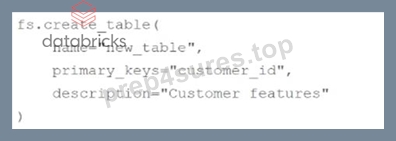
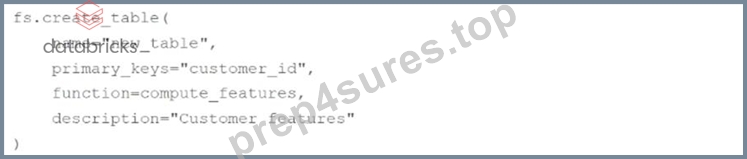
A data scientist has created a Python function compute_features that returns a Spark DataFrame with the following schema:
The resulting DataFrame is assigned to the features_df variable. The data scientist wants to create a Feature Store table using features_df.
Which of the following code blocks can they use to create and populate the Feature Store table using the Feature Store Client fs?
- A. features_df.write.mode("fs").path("new_table")
- B.

- C.
- D. features_df.write.mode("feature").path("new_table")
- E.
Answer: E
NEW QUESTION # 39
Which of the following statements describes streaming with Spark as a model deployment strategy?
- A. The inference of incrementally processed records as soon as a Spark job is run
- B. The inference of batch processed records as soon as a trigger is hit
- C. The inference of incrementally processed records as soon as trigger is hit
- D. The inference of batch processed records as soon as a Spark job is run
- E. The inference of all types of records in real-time
Answer: A
NEW QUESTION # 40
Which of the following is a benefit of logging a model signature with an MLflow model?
- A. The model will have a unique identifier in the MLflow experiment
- B. The schema of input data can be validated when serving models
- C. The model can be deployed using real-time serving tools
- D. The schema of input data will be converted to match the signature
- E. The model will be secured by the user that developed it
Answer: D
NEW QUESTION # 41
A machine learning engineering manager has asked all of the engineers on their team to add text descriptions to each of the model projects in the MLflow Model Registry. They are starting with the model project "model" and they'd like to add the text in the model_description variable.
The team is using the following line of code:
Which of the following changes does the team need to make to the above code block to accomplish the task?
- A. Replace description with artifact
- B. Replace update_registered_model with update_model_version
- C. Add a Python model as an argument to update_registered_model
- D. Replace client.update_registered_model with mlflow
- E. There no changes necessary
Answer: E
NEW QUESTION # 42
A machine learning engineer has developed a model and registered it using the FeatureStoreClient fs. The model has model URI model_uri. The engineer now needs to perform batch inference on customer-level Spark DataFrame spark_df, but it is missing a few of the static features that were used when training the model. The customer_id column is the primary key of spark_df and the training set used when training and logging the model.
Which of the following code blocks can be used to compute predictions for spark_df when the missing feature values can be found in the Feature Store by searching for features by customer_id?
- A. df = fs.get_missing_features(spark_df, model_uri)
fs.score_batch(model_uri, df)
df = fs.get_missing_features(spark_df) - B. df = fs.get_missing_features(spark_df, model_uri)
fs.score_model(model_uri, df) - C. fs.score_batch(model_uri, spark_df)
- D. fs.score_model(model_uri, spark_df)
- E. fs.score_batch(model_uri, df)
Answer: C
NEW QUESTION # 43
A data scientist would like to enable MLflow Autologging for all machine learning libraries used in a notebook. They want to ensure that MLflow Autologging is used no matter what version of the Databricks Runtime for Machine Learning is used to run the notebook and no matter what workspace-wide configurations are selected in the Admin Console.
Which of the following lines of code can they use to accomplish this task?
- A. mlflow.sklearn.autolog()
- B. mlflow.spark.autolog()
- C. spark.conf.set("autologging", True)
- D. It is not possible to automatically log MLflow runs.
- E. mlflow.autolog()
Answer: C
NEW QUESTION # 44
Which of the following lists all of the model stages are available in the MLflow Model Registry?
- A. Staging. Production. Archived
- B. Development. Staging. Production. Archived
- C. None. Staging. Production
- D. None. Staging. Production. Archived
- E. Development. Staging. Production
Answer: E
NEW QUESTION # 45
......
Latest Databricks-Machine-Learning-Professional Pass Guaranteed Exam Dumps Certification Sample Questions: https://www.prep4sures.top/Databricks-Machine-Learning-Professional-exam-dumps-torrent.html
Databricks-Machine-Learning-Professional Exam with Guarantee Updated 62 Questions: https://drive.google.com/open?id=1-vwQ0p_lpzsK0E9sH4Sc9FKv882tI12V