


2V0-21.23 Questions Prepare with Learning Information! 2026 Regularly updated
Get 2V0-21.23 Products Practice Material for 2V0-21.23 Exam Question Preparation
VMware vSphere 8.x Professional exam is an important part of the certification process for professionals who work with VMware technologies, and it is designed to test your knowledge and skills across a wide range of topics. 2V0-21.23 exam covers a variety of domains, including architecture and technologies, installation and configuration, security, performance optimization, and troubleshooting.
VMware 2V0-21.23 (VMware vSphere 8.x Professional) Certification Exam is designed for IT professionals who are seeking to enhance their skills and knowledge in virtualization technology. VMware vSphere 8.x Professional certification exam validates the ability of the candidates to install, configure, and manage VMware vSphere 8.x environments. It also tests their proficiency in troubleshooting and optimization of these environments.
The VMware 2V0-21.23 exam consists of 70 questions and has a time limit of 130 minutes. The questions are presented in multiple-choice format and cover a wide range of topics, including vSphere architecture and technologies, virtual machine management, storage management, networking, security, and troubleshooting. To pass the exam, you need to score at least 300 points out of a possible 500. The VMware 2V0-21.23 exam is a challenging test that requires a deep understanding of VMware vSphere 8.x technologies and their practical applications in real-world scenarios.
NEW QUESTION # 47
administrator successfully installs VMware ESXi onto the first host of a new vSphere duster but makes no additional configuration changes. When attempting to log into the vSphere Host Client using the Fully Qualified Domain Name (FQDN) of the host, the administrator receives the following error message:
''server Not Found -we can't connect to the server at esxit101.corp.local.''
* Host FQDN: esxi 101. Corp. local
* Management VLAN ID: 10
* DHCP: No
* Management IP Address: 172.16.10.101/24
* Management IP Gateway: 172.16.10.1
* Corporate DNS Servers: 172.16.10.5, 172.16.10.6
* DNS Domain: corp.local
Which three high level tasks should the administrator complete, at a minimum, in order to successfully log into the the vSphsrs Host Client using the FQDN for the exxi101 and complete the configuration (Choose three.)
- A. Update the VMware ESXI Management Network IPv4 configuration to use a static a IPv4 address.
- B. Disable IPv6 for the VMware ESXI Management Network.
- C. Ensure a DNS A Record Is created for the VMware ESXI host on the corporate DNS servers,
- D. Update the VMware ESXI Management Network DNS configuration to use the corporate DNS servers for name, resolution,
- E. Configure at least two network adapters for the VMware ESXI Management Network.
- F. Set the value of the VMware ESXI Management Network VLAN ID to 10.
Answer: C,D
Explanation:
To successfully log into the vSphere Host Client using the FQDN for the ESXi host, the administrator needs to ensure a DNS A Record is created for the VMware ESXi host on the corporate DNS servers, which maps its FQDN to its IP address; and update the VMware ESXi Management Network DNS configuration to use the corporate DNS servers for name resolution, which allows resolving its FQDN.
NEW QUESTION # 48
An administrator is tasked with configuring remote direct memory access (RDMA) over Converged Ethernet v2 (RoCE v2).
Which two types of adapters must the administrator configure? (Choose two.)
- A. Software NVMe over RDMA storage adapter
- B. RDMA network adapter
- C. Fibre Channel over Ethernet (FCoE) adapter
- D. Software iSCSi adapter
- E. Paravirtual RDMA adapter
Answer: B,C
Explanation:
ESXi 7 and later supports RoCE v2 technology, which enables RDMA over an Ethernet network. Hosts use an RDMA network adapter installed on the host and a software NVMe over RDMA storage adapter.
https://docs.vmware.com/en/VMware-vSphere/8.0/vsphere-storage/GUID-F4B42510-9E6D-4446-816A-5012866E0038.html
NEW QUESTION # 49
An administrator is responsible for the management of a VMware vCenter instance that is currently experience performance issues. The administrator quickly identifies that the CPU and memory utilization of vCenter is consistently over 90%. Upon further analysis, it seems that the vpxd process is contributing significantly to the performance issue.
A combination of which four steps should the administrator take to resolve the performance issues and ensure that a similar issue can be rectified without required downtime to vCenter moving forward? (Choose four.)
- A. Gracefully shut down vCenter using the vSphere Client.
- B. Enable CPU Hot add on the vCenter virtual machine.
- C. Power on the vCenter Server Appliance using the vSphere Host Client.
- D. Add a additional CPU and memory to the vCenter Server Appliance.
- E. Add a additional CPU and memory to the vCenter Server Appliance.
- F. Enable CPU an Memory Hot add on the vCenter virtual machine.
Answer: A,C,D,F
Explanation:
Explanation
References:
https://docs.vmware.com/en/VMware-vSphere/7.0/com.vmware.vsphere.vcenterhost.doc/GUID-8E7C1D6D-8E1
https://docs.vmware.com/en/VMware-vSphere/7.0/com.vmware.vsphere.vcenterhost.doc/GUID-3B41119A-1276
https://docs.vmware.com/en/VMware-vSphere/7.0/com.vmware.vsphere.vm_admin.doc/GUID-38F4D574-ADE
NEW QUESTION # 50
Refer to the exhibit.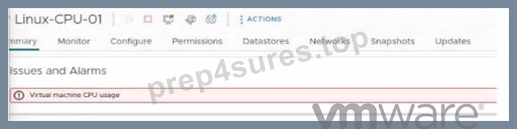
After removing an ESXi host from a cluster for maintenance, a number of virtual machines have encountered the warning seen in the exhibit. After re-adding the ESXi, the issue is resolved. Which step should the administrator take to move the triggered alarm to its normal state?
- A. Disable
- B. Ignore
- C. Acknowledge
- D. Reset to Green
Answer: D
Explanation:
Explanation
https://communities.vmware.com/t5/ESXi-Discussions/Alert-on-virtual-machine-that-i-cant-quot-clear-quot-or-r
NEW QUESTION # 51
An administrator is tasked with configuring remote direct memory access (RDMA) over Converged Ethernet v2 (RoCE v2).
Which two types of adapters must the administrator configure? (Choose two.)
- A. RDMA network adapter
- B. Software NVMe over RDMA storage adapter
- C. Software iSCSi adapter
- D. Fibre Channel over Ethernet (FCoE) adapter
- E. Paravirtual RDMA adapter
Answer: A,B
Explanation:
ESXi 7 and later supports RoCE v2 technology, which enables RDMA over an Ethernet network. Hosts use an RDMA network adapter installed on the host and a software NVMe over RDMA storage adapter.
https://docs.vmware.com/en/VMware-vSphere/8.0/vsphere-storage/GUID-F4B42510-9E6D-4446-816A-5012866E0038.html
NEW QUESTION # 52
An administrator creates a new corporate virtual machine (VM) template every month to include all of the latest patches. The administrator needs to ensure that the new VM template is synchronized from the primary data center site (London) to two secondary data center sites (Tokyo and New York). The administrator is aware that datastore space is limited within the secondary data center sites. The administrator needs to ensure that the VM template is available in the secondary sites the first time a new virtual machine is requested.
Which four steps should the administrator take to meet these requirements? (Choose four.)
- A. Create a new published content library at the primary site.
- B. Create a new subscribed content library in each secondary site.
- C. Add the virtual machine template to the published content library.
- D. Configure each subscribed content library to download content immediately.
- E. Add the virtual machine template to the subscribed content library.
- F. Create a new published content library in each secondary site.
- G. Configure the subscribed content library to download content when needed.
Answer: A,B,C,G
Explanation:
Explanation
To meet the requirements of synchronizing and protecting images and templates with limited datastore space, the administrator needs to create a new published content library at the primary site, which makes it available for subscription by other vCenter Server instances; create a new subscribed content library in each secondary site, which allows accessing content from a published content library; configure the subscribed content library to download content when needed, which saves datastore space by only downloading content on demand; and add the virtual machine template to the published content library, which makes it available for other hosts to use.
References:
https://docs.vmware.com/en/VMware-vSphere/7.0/com.vmware.vsphere.vm_admin.doc/GUID-FBEED81C-F9D
NEW QUESTION # 53
An administrator is adding a new ESXi host to an existing vSphere cluster. When selecting the cluster, the administrator Is unable to use the Cluster Quickstart workflow to add and configure the additional host.
What could be the root cause of this issue?
- A. The administrator has previously dismissed the Cluster Quickstart workflow.
- B. The administrator must manually add the host to the cluster before using the Cluster Quickstart workflow.
- C. The administrator has not been assigned the required permissions to use the Cluster Quickstart workflow.
- D. The administrator must enable the Cluster Quickstart workflow option in VMware vCenter.
Answer: A
Explanation:
Option A is correct because it indicates that the administrator has previously dismissed the Cluster Quickstart workflow, which will prevent them from using it to add and configure an additional host. To use the Cluster Quickstart workflow again, the administrator must enable it in the cluster settings. Option B is incorrect because the administrator does not need to manually add the host to the cluster before using the Cluster Quickstart workflow, as this is one of the steps in the workflow. Option C is incorrect because the administrator does not need any special permissions to use the Cluster Quickstart workflow, as long as they have permissions to perform cluster operations. Option D is incorrect because there is no option to enable the Cluster Quickstart workflow in VMware vCenter, as this is a feature of vSphere clusters. Reference: https://docs.vmware.com/en/VMware-vSphere/7.0/com.vmware.vsphere.vcenterhost.doc/GUID-9F9E3F8C-0E2B-4B6A-8C5C-3F8E5F6B4E9D.html
NEW QUESTION # 54
An administrator is asked to segregate virtual machine (VM) traffic by VLAN on a vSphere standard switch The following requirements must be met:
*VLAN ID on the switch port group must be 4095.
*VLAN tagging must be done at the VM level.
Which tagging mode is required?
- A. Virtual Switch Tagging (VST)
- B. External Switch Tagging (EST)
- C. Virtual Guest Tagging (VGT)
- D. None
Answer: C
Explanation:
Explanation
The tagging mode that is required is Virtual Guest Tagging (VGT), which allows VLAN tagging to be done at the VM level. VGT requires that the VLAN ID on the switch port group be set to 4095, which is a special value that indicates that packets from all VLANs are allowed to pass through. References:
https://docs.vmware.com/en/VMware-vSphere/7.0/com.vmware.vsphere.networking.doc/GUID-D35A0A1C-B6
https://kb.vmware.com/s/article/1003806
NEW QUESTION # 55
An administrator is planning to upgrade a VMware vCenter instance to version 8. It is currently integrated with the following solutions:
* VMware Aria Automation
* VMware Cloud Director
Which tool can the administrator use to run Interoperability reports before the upgrade process?
- A. vSphere Lifecycle Manager
- B. VMware Aria Suite Lifecycle
- C. vCenter Server Update Planner
- D. sphere Update Manager
Answer: C
Explanation:
Explanation
The tool that can be used to run interoperability reports before upgrading a vCenter Server instance is vCenter Server Update Planner, which allows checking compatibility with other VMware products.
References:
https://docs.vmware.com/en/VMware-vSphere/7.0/com.vmware.vcenter.upgrade.doc/GUID-C3FFBF62-D6BF-4
NEW QUESTION # 56
Which two tasks can be completed using vSphere LifeCycle Manager? (Choose two.)
- A. Check the hardware compatibility of the hosts in a cluster against the VMware Compatibility Guide (VCG) using baselines.
- B. Upgrade VMware vCenter from version 7 to 8.
- C. Manage the firmware lifecycle of ESXi hosts that are part of a managed cluster with a single image.
- D. Check that the ESXi hosts are compliant with the recommended baseline and update the hosts
- E. Manage the firmware lifecycle of ESXi hosts are part of a managed cluster using baselines
Answer: D,E
Explanation:
https://docs.vmware.com/en/VMware-vSphere/7.0/com.vmware.vsphere-lifecycle-manager.doc/GUID-774C3626-332C-4C3E-BC9B-AE648E78CA89.html#:~:text=In%20the%20Image%20pane%20of,ESXi%20hosts%20in%20the%20cluster.
NEW QUESTION # 57
An administrator creates a virtual machine that contains the latest company-approved software, tools and security updates. Company policy requires that only full clones are allowed for server workloads.
A combination of which two tasks should the administrator complete to prepare for the deployment of this virtual machine for multiple users? (Choose two.)
- A. Create a virtual machine customization specification.
- B. Set appropriate permissions on the virtual machine.
- C. Take a snapshot of the virtual machine.
- D. Upgrade the virtual hardware.
- E. Convert the virtual machine to a template.
Answer: A,E
Explanation:
Explanation
Option B and D are correct because they allow the administrator to create a virtual machine customization specification, which can be used to customize guest operating system settings for multiple virtual machines, and convert the virtual machine to a template, which can be used to create full clones of server workloads.
Option A is incorrect because assigning appropriate permissions on the virtual machine does not prepare it for deployment for multiple users. Option C is incorrect because upgrading the virtual hardware does not prepare it for deployment for multiple users. Option E is incorrect because taking a snapshot of the virtual machine does not prepare it for deployment for multiple users. References:
https://docs.vmware.com/en/VMware-vSphere/7.0/com.vmware.vsphere.vm_admin.doc/GUID-9F9E3F8C-0E2B
NEW QUESTION # 58
Refer to the exhibit.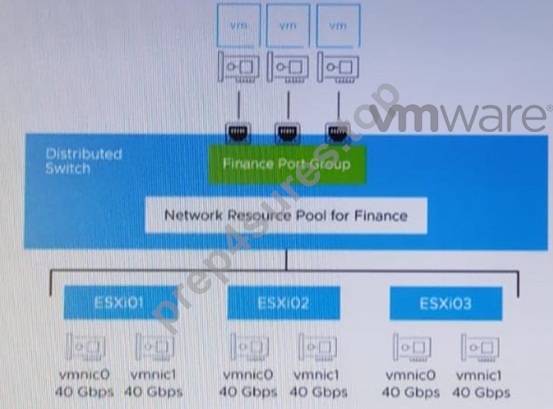
An administrator set up the following configuration:
* The distributed switch has three ESXi hosts, and each host has two 40 Gbps NICs.
* The amount of bandwidth reserved for virtual machine (VM) traffic is 6 Gbps.
The administrator wants to guarantee that VMs in the Finance distributed port group can access 50 percent of the available reserved bandwidth for VM traffic. k Given this scenario, what should the size (in Gbps) of the Finance network resource pool be?
- A. 0
- B. 1
- C. 2
- D. 3
Answer: B
Explanation:
Explanation
The size of the Finance network resource pool should be 50 percent of the reserved bandwidth for VM traffic, which is 6 Gbps x 3 hosts = 18 Gbps.
References:
https://docs.vmware.com/en/VMware-vSphere/7.0/com.vmware.vsphere.networking.doc/GUID-9F1D4E96-3392
NEW QUESTION # 59
An administrator is creating a content library to manage VM templates and ISO images. The administrator wants to password-protect the images and templates and share them with a remote site.
Which two tasks must the administration perform when creating the content library? (Choose two.)
- A. Enable authentication.
- B. Select an NFS datastore.
- C. Publish the local content library.
- D. Enable the security policy.
- E. Create a subscribed content library.
Answer: A,C
Explanation:
To password-protect and share images and templates with a remote site, the administrator needs to publish the local content library, which makes it available for subscription by other vCenter Server instances; and enable authentication, which requires users to enter credentials when accessing the content library.
NEW QUESTION # 60
An administrator is investigating user logon failures for a VMware vCenter instance Where can the administrator find log files containing information related to user login activities?
- A. On the vCenter Management Interface
- B. In the vSphere Client when viewing the vCenter virtual machine
- C. On the vCenter Server Appliance
- D. On the ESXi host using the Direct Console User Interface
Answer: C
Explanation:
The administrator can find log files containing information related to user login activities on the vCenter Server Appliance, which is a preconfigured Linux-based virtual machine that runs all vCenter Server services. The log files are located in /var/log/vmware/vmware-vpx/vpxd.log and /var/log/vmware/sso/ssoAdminServer.log directories. Reference: https://docs.vmware.com/en/VMware-vSphere/8.0/com.vmware.vsphere.troubleshooting.doc/GUID-5F9A7E49-5F9E-4F8A-BE6A-CAC5EE8E3734.html
NEW QUESTION # 61
What are three options an administrator can configure after creating a vSphere Namespace? (Choose three.)
- A. Update policies
- B. Certificates
- C. Resource and Object limits
- D. Storage policies
- E. Permissions
- F. Backup schedule
Answer: C,D,E
Explanation:
After creating a vSphere Namespace, three of the options that an administrator can configure are storage policies, which define how storage resources are allocated for objects within a namespace; permissions, which define who can access and manage objects within a namespace; and resource and object limits, which define how much CPU, memory, storage, and network resources can be consumed by objects within a namespace.
Reference:
https://docs.vmware.com/en/VMware-vSphere/8.0/vsphere-with-tanzu-services-workloads/GUID-177C23C4-ED81-4ADD-89A2-61654C18201B.html
NEW QUESTION # 62
An administrator is tasked with looking into the disaster recovery (DR) options for a software-defined data center (SDDC).
The following requirements must be met:
* All virtual machines (VMs) must be protected to a secondary site.
* The source VMs must remain online until the failover.
* When failing over to the secondary site, application downtime is allowed
* The DR failover must be managed from the vSphere Client.
* Costs must remain as low as possible.
How can the administrator accomplish this task?
- A. Configure VMware Site Recovery Manager and combine it with array-based storage replication.
- B. Configure VMware Cloud Disaster Recovery (VCDR) and combine it with array-based storage replication
- C. Configure VMware a Site Recovery Manager and combine it with vSphere Replication.
- D. Configure a subscribed content library on the secondary site.
Answer: C
Explanation:
https://blogs.vmware.com/virtualblocks/2017/11/29/vsr-technicaloverview/
NEW QUESTION # 63
......
Most Reliable VMware 2V0-21.23 Training Materials: https://www.prep4sures.top/2V0-21.23-exam-dumps-torrent.html
The Realest Study Materials 2V0-21.23 Dumps: https://drive.google.com/open?id=1P--SH0BzKwZXV5QKKAdAjSZnMt-RLQsR