


May 02, 2022 Reliable Study Materials for Professional-Machine-Learning-Engineer Exam Success For Sure
100% Latest Most updated Professional-Machine-Learning-Engineer Questions and Answers
Who should take the Professional Machine Learning Engineer - Google
A Professional Machine Learning Engineer designs, builds, and productionizes ML models to solve business challenges using Google Cloud technologies and knowledge of proven ML models and techniques. The ML Engineer collaborates closely with other job roles to ensure long-term success of models. The ML Engineer should be proficient in all aspects of model architecture, data pipeline interaction, and metrics interpretation. The ML Engineer needs familiarity with application development, infrastructure management, data engineering, and security. Through an understanding of training, retraining, deploying, scheduling, monitoring, and improving models, they design and create scalable solutions for optimal performance.
The Google Professional-Machine-Learning-Engineer exam is for entry-level IT specialists and organization professionals with standard knowledge of the Google platform. The Google CCP certification validates the potential client's understanding of these topics and their skills; standard building principles, key services and also their use cases, security, and protection, as well as compliance with the Google model, paid versions, and prices. Google Professional-Machine-Learning-Engineer exam is the appropriate starting point for Google certification and is also an excellent resource for those interested in non-technical projects.
NEW QUESTION 31
You are working on a Neural Network-based project. The dataset provided to you has columns with different ranges. While preparing the data for model training, you discover that gradient optimization is having difficulty moving weights to a good solution. What should you do?
- A. Use feature construction to combine the strongest features.
- B. Change the partitioning step to reduce the dimension of the test set and have a larger training set.
- C. Use the representation transformation (normalization) technique.
- D. Improve the data cleaning step by removing features with missing values.
Answer: D
NEW QUESTION 32
You are training an LSTM-based model on Al Platform to summarize text using the following job submission script: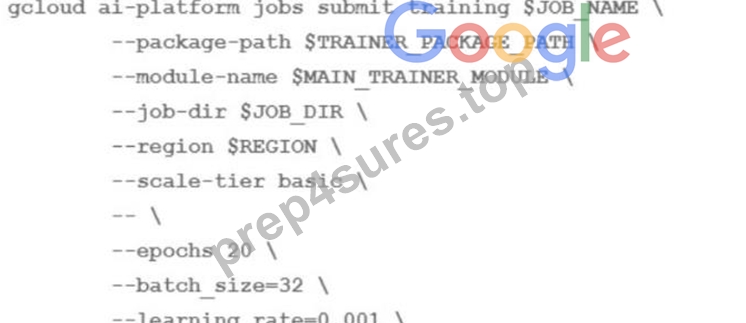
You want to ensure that training time is minimized without significantly compromising the accuracy of your model. What should you do?
- A. Modify the 'learning rate' parameter
- B. Modify the 'scale-tier' parameter
- C. Modify the batch size' parameter
- D. Modify the 'epochs' parameter
Answer: C
NEW QUESTION 33
A Machine Learning Specialist must build out a process to query a dataset on Amazon S3 using Amazon Athena. The dataset contains more than 800,000 records stored as plaintext CSV files. Each record contains
200 columns and is approximately 1.5 MB in size. Most queries will span 5 to 10 columns only.
How should the Machine Learning Specialist transform the dataset to minimize query runtime?
- A. Convert the records to XML format.
- B. Convert the records to GZIP CSV format.
- C. Convert the records to JSON format.
- D. Convert the records to Apache Parquet format.
Answer: D
Explanation:
Using compressions will reduce the amount of data scanned by Amazon Athena, and also reduce your S3 bucket storage. It's a Win-Win for your AWS bill. Supported formats: GZIP, LZO, SNAPPY (Parquet) and ZLIB.
Reference: https://www.cloudforecast.io/blog/using-parquet-on-athena-to-save-money-on-aws/
NEW QUESTION 34
A Data Scientist is developing a machine learning model to predict future patient outcomes based on information collected about each patient and their treatment plans. The model should output a continuous value as its prediction. The data available includes labeled outcomes for a set of 4,000 patients. The study was conducted on a group of individuals over the age of 65 who have a particular disease that is known to worsen with age.
Initial models have performed poorly. While reviewing the underlying data, the Data Scientist notices that, out of 4,000 patient observations, there are 450 where the patient age has been input as 0. The other features for these observations appear normal compared to the rest of the sample population How should the Data Scientist correct this issue?
- A. Use k-means clustering to handle missing features
- B. Replace the age field value for records with a value of 0 with the mean or median value from the dataset
- C. Drop the age feature from the dataset and train the model using the rest of the features.
- D. Drop all records from the dataset where age has been set to 0.
Answer: D
Explanation:
Explanation
NEW QUESTION 35
You have been asked to develop an input pipeline for an ML training model that processes images from disparate sources at a low latency. You discover that your input data does not fit in memory. How should you create a dataset following Google-recommended best practices?
- A. Convert the images to tf .Tensor Objects, and then run Dataset. from_tensor_slices{).
- B. Convert the images to tf .Tensor Objects, and then run tf. data. Dataset. from_tensors ().
- C. Create a tf.data.Dataset.prefetch transformation
- D. Convert the images Into TFRecords, store the images in Cloud Storage, and then use the tf. data API to read the images for training
Answer: D
NEW QUESTION 36
You were asked to investigate failures of a production line component based on sensor readings. After receiving the dataset, you discover that less than 1% of the readings are positive examples representing failure incidents. You have tried to train several classification models, but none of them converge. How should you resolve the class imbalance problem?
- A. Use a convolutional neural network with max pooling and softmax activation
- B. Remove negative examples until the numbers of positive and negative examples are equal
- C. Use the class distribution to generate 10% positive examples
- D. Downsample the data with upweighting to create a sample with 10% positive examples
Answer: B
NEW QUESTION 37
You work for a global footwear retailer and need to predict when an item will be out of stock based on historical inventory dat a. Customer behavior is highly dynamic since footwear demand is influenced by many different factors. You want to serve models that are trained on all available data, but track your performance on specific subsets of data before pushing to production. What is the most streamlined and reliable way to perform this validation?
- A. Use the TFX ModelValidator tools to specify performance metrics for production readiness
- B. Use k-fold cross-validation as a validation strategy to ensure that your model is ready for production.
- C. Use the entire dataset and treat the area under the receiver operating characteristics curve (AUC ROC) as the main metric.
- D. Use the last relevant week of data as a validation set to ensure that your model is performing accurately on current data
Answer: A
NEW QUESTION 38
A Machine Learning Specialist is developing a daily ETL workflow containing multiple ETL jobs. The workflow consists of the following processes:
* Start the workflow as soon as data is uploaded to Amazon S3.
* When all the datasets are available in Amazon S3, start an ETL job to join the uploaded datasets with multiple terabyte-sized datasets already stored in Amazon S3.
* Store the results of joining datasets in Amazon S3.
* If one of the jobs fails, send a notification to the Administrator.
Which configuration will meet these requirements?
- A. Use AWS Lambda to trigger an AWS Step Functions workflow to wait for dataset uploads to complete in Amazon S3. Use AWS Glue to join the datasets. Use an Amazon CloudWatch alarm to send an SNS notification to the Administrator in the case of a failure.
- B. Develop the ETL workflow using AWS Lambda to start an Amazon SageMaker notebook instance. Use a lifecycle configuration script to join the datasets and persist the results in Amazon S3. Use an Amazon CloudWatch alarm to send an SNS notification to the Administrator in the case of a failure.
- C. Develop the ETL workflow using AWS Batch to trigger the start of ETL jobs when data is uploaded to Amazon S3. Use AWS Glue to join the datasets in Amazon S3. Use an Amazon CloudWatch alarm to send an SNS notification to the Administrator in the case of a failure.
- D. Use AWS Lambda to chain other Lambda functions to read and join the datasets in Amazon S3 as soon as the data is uploaded to Amazon S3. Use an Amazon CloudWatch alarm to send an SNS notification to the Administrator in the case of a failure.
Answer: A
Explanation:
Explanation/Reference: https://aws.amazon.com/step-functions/use-cases/
NEW QUESTION 39
You are building an ML model to detect anomalies in real-time sensor dat a. You will use Pub/Sub to handle incoming requests. You want to store the results for analytics and visualization. How should you configure the pipeline?
- A. 1 = BigQuery, 2 = AutoML, 3 = Cloud Functions
- B. 1 = Dataflow, 2 - Al Platform, 3 = BigQuery
- C. 1 = BigQuery, 2 = Al Platform, 3 = Cloud Storage
- D. 1 = DataProc, 2 = AutoML, 3 = Cloud Bigtable
Answer: A
NEW QUESTION 40
You work for a large technology company that wants to modernize their contact center. You have been asked to develop a solution to classify incoming calls by product so that requests can be more quickly routed to the correct support team. You have already transcribed the calls using the Speech-to-Text API. You want to minimize data preprocessing and development time. How should you build the model?
- A. Use AutoML Natural Language to extract custom entities for classification
- B. Use the Cloud Natural Language API to extract custom entities for classification
- C. Use the Al Platform Training built-in algorithms to create a custom model
- D. Build a custom model to identify the product keywords from the transcribed calls, and then run the keywords through a classification algorithm
Answer: C
NEW QUESTION 41
You are an ML engineer at a global car manufacturer. You need to build an ML model to predict car sales in different cities around the world. Which features or feature crosses should you use to train city-specific relationships between car type and number of sales?
- A. One feature obtained as an element-wise product between latitude, longitude, and car type
- B. Two feature crosses as a element-wise product the first between binned latitude and one-hot encoded car type, and the second between binned longitude and one-hot encoded car type
- C. Three individual features binned latitude, binned longitude, and one-hot encoded car type
- D. One feature obtained as an element-wise product between binned latitude, binned longitude, and one-hot encoded car type
Answer: C
NEW QUESTION 42
An online reseller has a large, multi-column dataset with one column missing 30% of its data. A Machine Learning Specialist believes that certain columns in the dataset could be used to reconstruct the missing data.
Which reconstruction approach should the Specialist use to preserve the integrity of the dataset?
- A. Multiple imputation
- B. Listwise deletion
- C. Mean substitution
- D. Last observation carried forward
Answer: A
Explanation:
Explanation/Reference: https://worldwidescience.org/topicpages/i/imputing+missing+values.html
NEW QUESTION 43
A technology startup is using complex deep neural networks and GPU compute to recommend the company's products to its existing customers based upon each customer's habits and interactions. The solution currently pulls each dataset from an Amazon S3 bucket before loading the data into a TensorFlow model pulled from the company's Git repository that runs locally. This job then runs for several hours while continually outputting its progress to the same S3 bucket. The job can be paused, restarted, and continued at any time in the event of a failure, and is run from a central queue.
Senior managers are concerned about the complexity of the solution's resource management and the costs involved in repeating the process regularly. They ask for the workload to be automated so it runs once a week, starting Monday and completing by the close of business Friday.
Which architecture should be used to scale the solution at the lowest cost?
- A. Implement the solution using AWS Deep Learning Containers, run the workload using AWS Fargate running on Spot Instances, and then schedule the task using the built-in task scheduler
- B. Implement the solution using a low-cost GPU-compatible Amazon EC2 instance and use the AWS Instance Scheduler to schedule the task
- C. Implement the solution using Amazon ECS running on Spot Instances and schedule the task using the ECS service scheduler
- D. Implement the solution using AWS Deep Learning Containers and run the container as a job using AWS Batch on a GPU-compatible Spot Instance
Answer: A
NEW QUESTION 44
A Machine Learning team uses Amazon SageMaker to train an Apache MXNet handwritten digit classifier model using a research dataset. The team wants to receive a notification when the model is overfitting.
Auditors want to view the Amazon SageMaker log activity report to ensure there are no unauthorized API calls.
What should the Machine Learning team do to address the requirements with the least amount of code and fewest steps?
- A. Implement an AWS Lambda function to log Amazon SageMaker API calls to Amazon S3. Add code to push a custom metric to Amazon CloudWatch. Create an alarm in CloudWatch with Amazon SNS to receive a notification when the model is overfitting.
- B. Use AWS CloudTrail to log Amazon SageMaker API calls to Amazon S3. Set up Amazon SNS to receive a notification when the model is overfitting
- C. Use AWS CloudTrail to log Amazon SageMaker API calls to Amazon S3. Add code to push a custom metric to Amazon CloudWatch. Create an alarm in CloudWatch with Amazon SNS to receive a notification when the model is overfitting.
- D. Implement an AWS Lambda function to log Amazon SageMaker API calls to AWS CloudTrail. Add code to push a custom metric to Amazon CloudWatch. Create an alarm in CloudWatch with Amazon SNS to receive a notification when the model is overfitting.
Answer: D
NEW QUESTION 45
A Machine Learning Specialist previously trained a logistic regression model using scikit-learn on a local machine, and the Specialist now wants to deploy it to production for inference only.
What steps should be taken to ensure Amazon SageMaker can host a model that was trained locally?
- A. Serialize the trained model so the format is compressed for deployment. Tag the Docker image with the registry hostname and upload it to Amazon S3.
- B. Build the Docker image with the inference code. Tag the Docker image with the registry hostname and upload it to Amazon ECR.
- C. Serialize the trained model so the format is compressed for deployment. Build the image and upload it to Docker Hub.
- D. Build the Docker image with the inference code. Configure Docker Hub and upload the image to Amazon ECR.
Answer: D
NEW QUESTION 46
You have trained a text classification model in TensorFlow using Al Platform. You want to use the trained model for batch predictions on text data stored in BigQuery while minimizing computational overhead. What should you do?
- A. Deploy and version the model on Al Platform.
- B. Submit a batch prediction job on Al Platform that points to the model location in Cloud Storage.
- C. Use Dataflow with the SavedModel to read the data from BigQuery
- D. Export the model to BigQuery ML.
Answer: D
NEW QUESTION 47
Machine Learning Specialist is training a model to identify the make and model of vehicles in images. The Specialist wants to use transfer learning and an existing model trained on images of general objects. The Specialist collated a large custom dataset of pictures containing different vehicle makes and models.
What should the Specialist do to initialize the model to re-train it with the custom data?
- A. Initialize the model with random weights in all layers and replace the last fully connected layer.
- B. Initialize the model with pre-trained weights in all layers and replace the last fully connected layer.
- C. Initialize the model with pre-trained weights in all layers including the last fully connected layer.
- D. Initialize the model with random weights in all layers including the last fully connected layer.
Answer: B
Explanation:
Explanation/Reference:
NEW QUESTION 48
A Data Science team within a large company uses Amazon SageMaker notebooks to access data stored in Amazon S3 buckets. The IT Security team is concerned that internet-enabled notebook instances create a security vulnerability where malicious code running on the instances could compromise data privacy. The company mandates that all instances stay within a secured VPC with no internet access, and data communication traffic must stay within the AWS network.
How should the Data Science team configure the notebook instance placement to meet these requirements?
- A. Associate the Amazon SageMaker notebook with a private subnet in a VPC. Ensure the VPC has S3 VPC endpoints and Amazon SageMaker VPC endpoints attached to it.
- B. Associate the Amazon SageMaker notebook with a private subnet in a VPC. Use IAM policies to grant access to Amazon S3 and Amazon SageMaker.
- C. Associate the Amazon SageMaker notebook with a private subnet in a VPC. Ensure the VPC has a NAT gateway and an associated security group allowing only outbound connections to Amazon S3 and Amazon SageMaker.
- D. Associate the Amazon SageMaker notebook with a private subnet in a VPC. Place the Amazon SageMaker endpoint and S3 buckets within the same VPC.
Answer: A
NEW QUESTION 49
You are training an LSTM-based model on Al Platform to summarize text using the following job submission script:
You want to ensure that training time is minimized without significantly compromising the accuracy of your model. What should you do?
- A. Modify the 'learning rate' parameter
- B. Modify the batch size' parameter
- C. Modify the 'scale-tier' parameter
- D. Modify the 'epochs' parameter
Answer: D
NEW QUESTION 50
You are building a linear regression model on BigQuery ML to predict a customer's likelihood of purchasing your company's products. Your model uses a city name variable as a key predictive component. In order to train and serve the model, your data must be organized in columns. You want to prepare your data using the least amount of coding while maintaining the predictable variables. What should you do?
- A. Use Cloud Data Fusion to assign each city to a region labeled as 1, 2, 3, 4, or 5r and then use that number to represent the city in the model.
- B. Create a new view with BigQuery that does not include a column with city information
- C. Use TensorFlow to create a categorical variable with a vocabulary list Create the vocabulary file, and upload it as part of your model to BigQuery ML.
- D. Use Dataprep to transform the state column using a one-hot encoding method, and make each city a column with binary values.
Answer: A
NEW QUESTION 51
Your organization's call center has asked you to develop a model that analyzes customer sentiments in each call. The call center receives over one million calls daily, and data is stored in Cloud Storage. The data collected must not leave the region in which the call originated, and no Personally Identifiable Information (Pll) can be stored or analyzed. The data science team has a third-party tool for visualization and access which requires a SQL ANSI-2011 compliant interface. You need to select components for data processing and for analytics. How should the data pipeline be designed?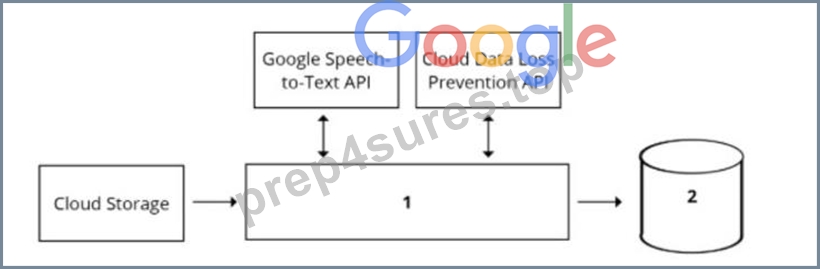
- A. 1 = Dataflow, 2 = Cloud SQL
- B. 1 = Dataflow, 2 = BigQuery
- C. 1 = Cloud Function, 2 = Cloud SQL
- D. 1 = Pub/Sub, 2 = Datastore
Answer: D
NEW QUESTION 52
An interactive online dictionary wants to add a widget that displays words used in similar contexts. A Machine Learning Specialist is asked to provide word features for the downstream nearest neighbor model powering the widget.
What should the Specialist do to meet these requirements?
- A. Create word embedding vectors that store edit distance with every other word.
- B. Create one-hot word encoding vectors.
- C. Produce a set of synonyms for every word using Amazon Mechanical Turk.
- D. Download word embeddings pre-trained on a large corpus.
Answer: B
Explanation:
Explanation/Reference: https://aws.amazon.com/blogs/machine-learning/amazon-sagemaker-object2vec-adds-new- features-that-support-automatic-negative-sampling-and-speed-up-training/
NEW QUESTION 53
A Data Engineer needs to build a model using a dataset containing customer credit card information How can the Data Engineer ensure the data remains encrypted and the credit card information is secure?
- A. Use an Amazon SageMaker launch configuration to encrypt the data once it is copied to the SageMaker instance in a VPC. Use the SageMaker principal component analysis (PCA) algorithm to reduce the length of the credit card numbers.
- B. Use an IAM policy to encrypt the data on the Amazon S3 bucket and Amazon Kinesis to automatically discard credit card numbers and insert fake credit card numbers.
- C. Use a custom encryption algorithm to encrypt the data and store the data on an Amazon SageMaker instance in a VPC. Use the SageMaker DeepAR algorithm to randomize the credit card numbers.
- D. Use AWS KMS to encrypt the data on Amazon S3 and Amazon SageMaker, and redact the credit card numbers from the customer data with AWS Glue.
Answer: A
Explanation:
Explanation/Reference: https://docs.aws.amazon.com/sagemaker/latest/dg/pca.html
NEW QUESTION 54
You are developing models to classify customer support emails. You created models with TensorFlow Estimators using small datasets on your on-premises system, but you now need to train the models using large datasets to ensure high performance. You will port your models to Google Cloud and want to minimize code refactoring and infrastructure overhead for easier migration from on-prem to cloud. What should you do?
- A. Use Kubeflow Pipelines to train on a Google Kubernetes Engine cluster.
- B. Create a Managed Instance Group with autoscaling
- C. Use Al Platform for distributed training
- D. Create a cluster on Dataproc for training
Answer: B
NEW QUESTION 55
Your team is building a convolutional neural network (CNN)-based architecture from scratch. The preliminary experiments running on your on-premises CPU-only infrastructure were encouraging, but have slow convergence. You have been asked to speed up model training to reduce time-to-market. You want to experiment with virtual machines (VMs) on Google Cloud to leverage more powerful hardware. Your code does not include any manual device placement and has not been wrapped in Estimator model-level abstraction. Which environment should you train your model on?
- A. AVM on Compute Engine and 8 GPUs with all dependencies installed manually.
- B. A Deep Learning VM with an n1-standard-2 machine and 1 GPU with all libraries pre-installed.
- C. A Deep Learning VM with more powerful CPU e2-highcpu-16 machines with all libraries pre-installed.
- D. AVM on Compute Engine and 1 TPU with all dependencies installed manually.
Answer: D
NEW QUESTION 56
......
New Google Professional-Machine-Learning-Engineer Dumps & Questions: https://www.prep4sures.top/Professional-Machine-Learning-Engineer-exam-dumps-torrent.html
Try with 100% Real Exam Questions and Answers: https://drive.google.com/open?id=1JbTidRVq-majP9leUUfZpD-9bfpxwbPY