


Prep4sures Data-Integration-Developer Exam Questions | Real Data-Integration-Developer Practice Dumps
Verified Data-Integration-Developer Exam Dumps Q&As - Provide Data-Integration-Developer with Correct Answers
Talend Data-Integration-Developer Exam Syllabus Topics:
| Topic | Details |
|---|---|
| Topic 1 |
|
| Topic 2 |
|
| Topic 3 |
|
| Topic 4 |
|
| Topic 5 |
|
| Topic 6 |
|
| Topic 7 |
|
| Topic 8 |
|
NEW QUESTION # 27
Which statements are true about Use or register ashared DB Connection option in Talend Studio?
Choose 3 answers
- A. Incompatible with the Use dynamic job option of tRunJob component
- B. Compatible tobesnared between parent and childJobs
- C. Incompatible with the Use an independent process to run subJob option of tRunJob component
- D. Compatible with the Use an independent process to run subJob option of tKunJob component
- E. Compatiblewith The Use dynamicjob option of TRunJob component
Answer: A,B,C
Explanation:
Explanation
The Use or register a shared DB Connection option in Talend Studio is an option that allows you to share a single database connection between multiple components in a job or between parent and child jobs. This option can improve the performance and efficiency of your job by avoiding opening and closing multiple connections to the same database. The Use or register a shared DB Connection option is compatible with the following scenarios:
Sharing a connection between parent and child jobs. You can use this option to pass a database connection from a parent job to a child job that is called by a tRunJob component. This way, you do not need to create a new connection in the child job, but reuse the existing one from the parent job.
Sharing a connection between components in the same subjob. You can use this option to register a database connection in one component (such as tMysqlConnection) and use it in other components (such as tMysqlInput or tMysqlOutput) in the same subjob. This way, you do not need to configure each component with the same connection properties, but use a shared one.
The Use or register a shared DB Connection option is incompatible with the following scenarios:
Using an independent process to run subjob option of tRunJob component. This option allows you to run a child job in a separate JVM process from the parent job. This option is not compatible with sharing a database connection, because each JVM process has its own memory space and cannot access the objects of another process.
Using dynamic job option of tRunJob component. This option allows you to call a child job dynamically based on a context variable that contains the name of the child job. This option is not compatible with sharing a database connection, because dynamic jobs are loaded at runtime and cannot access the metadata of other jobs. References: Talend Open Studio: Open-source ETL and Free Data Integration | Talend, [Use or register a shared DB Connection - 7.3], [tRunJob properties - 7.3]
NEW QUESTION # 28
You are using the tMap component to configure a mapping.
What do the tables on the left side of the Map Editor window represent?
- A. Explosions to apply to the input data
- B. Expression to apply to the output data
- C. Schemas of the input rows
- D. Schemas of the output rows
Answer: C
Explanation:
Explanation
The tables on the left side of the Map Editor window represent the schemas of the input rows. The schemas define the structure and type of the data that is coming from the input components connected to the tMap component. You can drag and drop columns from the input tables to the output tables on the right side of the Map Editor window to create mappings and transformations.
NEW QUESTION # 29
A colleague has exported a Data Integration Job to run outside Talend Studio.
How do you run the Job?
- A. Extract the files from the archive and run the JAR file.
- B. Install the Job and start the resulting service.
- C. Extract the contents of the archive and run the batch file and shell script.
- D. Extract the content of the archive and run the batch file or the shell script.
Answer: D
Explanation:
Explanation
To run a job that has been exported by a colleague to run outside Talend Studio, you need to extract the content of the archive and run the batch file or the shell script. The archive file contains all the files and libraries required to run the job independently from Talend Studio on any platform that supports Java. The archive file also contains two executable files: a batch file (.bat) for Windows platforms and a shell script (.sh) for Linux platforms. You need to run the appropriate file for your platform by double-clicking on it or using a command line tool. This will launch the job and display its output in a console window.
You do not need to extract the contents of the archive and run both the batch file and shell script, install the job and start the resulting service, or extract the files from the archive and run the JAR file. These methods are not correct or available in Talend Studio and may cause errors or unexpected results. References: Talend Open Studio: Open-source ETL and Free Data Integration | Talend, [Build Job - 7.3]
NEW QUESTION # 30
Which element carries data between two components in a Job?
- A. Sublob
- B. Row
- C. Trigger
- D. Link
Answer: B
Explanation:
Explanation
A row is an element that carries data between two components in a Job. A row is also called a link or a connector. A row can be of different types, such as Main, Lookup, Reject, Iterate, etc. A subjob is a group of components that are connected together and executed as a single unit. A trigger is an element that controls the execution flow of a Job or a subjob. A trigger can be of different types, such as OnSubjobOk, OnComponentOk, RunIf, etc.
NEW QUESTION # 31
You have two Talend Jobs. Job A need to call Job B. After Job B is complete, processed data stored in the tBufferOutput buffer memory must be transferred back to Job A.
How can you achieve this requirement?
- A. Select the Transmit whole context in Advanced settings of the tRunJob when calling Job B from Job A.
- B. Select the Propagate the child result to output schema in Advanced settings of the tRunJob when calling Job B from Job B.
- C. Select the Transmit whole context in the basic settings of the tRunJob when calling Job B from Job A.
- D. Select the Propagate the child result to output schema in the Basicsettings of the tRunJob when calling B from Job A.
Answer: B
Explanation:
Explanation
To call a different job within a job you are developing, you can use the tRunJob component. This component allows you to execute another job as a subjob within a parent job. To pass the parameters to the job you want to call, you can use the context parameters. Context parameters are variables that can store values that can be changed at runtime or between different contexts. You can define context parameters in the Contexts tab of your job and assign them values for each context. You can also pass context parameters from the parent job to the child job by using the Context Param tab of the tRunJob component. This way, you can parameterize the properties or expressions of the child job with the values from the parent job.
To transfer processed data stored in the tBufferOutput buffer memory back to the parent job, you need to select the Propagate the child result to output schema option in the Advanced settings of the tRunJob component. This option allows you to retrieve the data from the tBufferOutput component of the child job and send it to an output row of the parent job. The tBufferOutput component is used to store data in memory without writing it to disk or database. You can use this component to optimize the performance and memory usage of your job.
You do not need to select the Transmit whole context option in either Basic or Advanced settings of the tRunJob component. This option allows you to pass all the context parameters from the parent job to the child job without specifying them individually. This option does not affect the data transfer from the tBufferOutput component. You also do not need to select the Propagate the child result to output schema option in Basic settings of the tRunJob component, as this option is only available in Advanced settings. References: Talend Open Studio: Open-source ETL and Free Data Integration | Talend, [tRunJob properties - 7.3], [tBufferOutput properties - 7.3], [Contexts - 7.3]
NEW QUESTION # 32
A Job has two contexts defined: lest (the default) and Prod, and two context variables defined: path and server.
Which expression should you use to reference the path?
- A. context(path)
- B. context, path
- C. contex,(test.Prod).path
- D. context.Tfblpdtr1
Answer: B
Explanation:
Explanation
To reference the value of a context variable you defined, you can use the syntax context.variable_name, where variable_name is the name of the context variable. For example, if you have a context variable named path, you can reference its value by using context.path. You do not need to specify the context name (such as test or prod) or use parentheses or brackets around the variable name. References: Talend Data Integration - Software to Connect, Access, and Transform Data | Talend,
NEW QUESTION # 33
You need to create a centralized metadata connection to database server for an application.
Which steps should you take before building a Job that reads from that database?
Choose 3 answers
- A. Add a tMap component handle and convert DB Types.
- B. Create DB Connections metadata to describe the database connection.
- C. Drag the Db Connection metadata into the Designer to read from the database component.
- D. Add a tCreatTable component to create a table in the database.
- E. Retrieve schemas from the database connection.
Answer: B,C,E
Explanation:
Explanation
To create a centralized metadata connection to a database server for an application, you need to take the following steps before building a job that reads from that database:
Create DB Connections metadata to describe the database connection. You can do this by right-clicking on the DB Connections node in the Repository and selecting Create Connection. You can then enter the connection details, such as host, port, database, username, password, etc., and test the connection.
Retrieve schemas from the database connection. You can do this by expanding the DB Connections node in the Repository and right-clicking on the connection you created. You can then select Retrieve Schema and choose the tables or views you want to import as metadata schemas. You can also edit or customize the schemas as needed.
Drag the DB Connection metadata into the Designer to read from the database component. You can do this by dragging the connection or a specific schema from the Repository to the Designer workspace.
This will automatically create a database input component (such as tMysqlInput) that is configured with the connection and schema properties. You can then use this component to read data from the database in your job.
You do not need to add a tMap component to handle and convert DB Types, nor a tCreateTable component to create a table in the database. These components are not required for reading data from an existing database, but they can be used for other purposes, such as transforming or writing data. References: Talend Open Studio: Open-source ETL and Free Data Integration | Talend, [DB Connections - 7.3], [tMap properties - 7.3],
[tCreateTable properties - 7.3]
NEW QUESTION # 34
You need to call a different Job within a Job you are developing.
Which mechanism allows you to pass the parameters to the lob you want to call?
- A. Java Function paramters
- B. CommandLine options
- C. File
- D. Context parameters
Answer: D
Explanation:
Explanation
To call a different job within a job you are developing, you can use the tRunJob component. This component allows you to execute another job as a subjob within a parent job. To pass the parameters to the job you want to call, you can use the context parameters. Context parameters are variables that can store values that can be changed at runtime or between different contexts. You can define context parameters in the Contexts tab of your job and assign them values for each context. You can also pass context parameters from the parent job to the child job by using the Context Param tab of the tRunJob component. This way, you can parameterize the properties or expressions of the child job with the values from the parent job.
You do not need to use a file, command line options, or Java function parameters to pass parameters to a different job. These methods are not supported by Talend Studio and may cause errors or unexpected results. References: Talend Open Studio: Open-source ETL and Free Data Integration | Talend, [tRunJob properties - 7.3], [Contexts - 7.3]
NEW QUESTION # 35
You created a Job to process a customer database. Next, you want to debug the Job using Traces Debug and pause the execution when it encounters any records for customers residing in the state of California.
- A. Add a breakpoint in the Advanced Settings tab of the Run view.
- B. Open the Debug Run tab of the Run view and click Traces Debug.
- C. Right-click the trace on the output of the input component and select Add Breakpoint.
- D. Right-click the trace on the output of the input component and select Show Breakpoint Setup.
Answer: D
Explanation:
Explanation
To debug a job using Trace Debug mode and pause the execution when it encounters any records for customers residing in the state of California, you need to right-click on the trace on the output of the input component and select Show Breakpoint Setup option. Trace Debug mode is a feature that allows you to trace each row processed by your job components and see the values of each column in each row. You can access this mode by opening the Debug Run tab of the Run view and clicking on Trace Debug button. A trace is a link that shows the data flow between components in your job design workspace.
The Show Breakpoint Setup option allows you to set a breakpoint on a trace based on a condition or an expression. A breakpoint is a point where the execution of your job pauses and waits for your action. You can use breakpoints to inspect your data or debug your logic at specific points of your job execution. You can access this option by right-clicking on a trace on your job design workspace and selecting Show Breakpoint Setup. This will open a dialog box where you can enter a condition or an expression for your breakpoint.
For example, if you want to pause your job execution when it encounters any records for customers residing in the state of California, you can enter this condition for your breakpoint:
row1.state == "CA"
This will make your job stop at the trace where this condition is met and show you the values of each column for that row.
You do not need to add a breakpoint in Advanced settings tab of Run view, open Debug Run tab of Run view and click Trace Debug button, or right-click on trace on output of input component and select Add Breakpoint option. These options are not used to set breakpoints based on conditions or expressions. The Advanced settings tab of Run view is used to configure advanced settings for your job execution, such as JVM arguments, statistics parameters, implicit context load parameters, etc. The Debug Run tab of Runview is used to access Trace Debug mode, but not to set breakpoints. The Add Breakpoint option is used to add a simple breakpoint on a trace without any condition or expression. References: Talend Open Studio: Open-source ETL and Free Data Integration | Talend, [Trace Debug mode - 7.3], [Breakpoints - 7.3]
NEW QUESTION # 36
How do you create an empty Joblet?
- A. Right-clicking a space in the Designer and select refactor to Joblect.
- B. Right-click Joblet Designs the Repository and select Create Joblet.
- C. Create an empty Job, then export it as a Joblet by right-clicking it in the Repository.
- D. Create an empty Jon and use the file menu to save it as Joblet.
Answer: B
Explanation:
Explanation
To create an empty Joblet, you need to right-click on the Joblet Designs node in the Repository tree view and select Create Joblet option. This will open a dialog box whereyou can enter the name and description of your Joblet and select an icon for it. You can then design your Joblet by adding components and links to it in the Designer workspace.
You cannot create an empty Joblet by creating an empty job, then exporting it as a Joblet by right-clicking it in the Repository, creating an empty job and using the file menu to save it as Joblet, or right-clicking a space in the Designer and selecting refactor to Joblet. These methods are not available in Talend Studio and may cause errors or unexpected results. References: Talend Open Studio: Open-source ETL and Free Data Integration | Talend, [Joblets - 7.3]
NEW QUESTION # 37
Where can you specify the remote JobServer to execute a Job?
- A. Run/Debug section in the Preference window
- B. Target Exec tab in the Run view
- C. Extra tab in the Job view
- D. Job settings section of the Project Settings windows
Answer: B
Explanation:
Explanation
To specify the remote JobServer to execute a job, you need to use the Target Exec tab in the Run view of Talend Studio. The Run view allows you to configure and execute your job from Talend Studio. The Target Exec tab allows you to select whether you want to run your job locally or remotely on a JobServer. A JobServer is a server application that allows you to execute jobs remotely from Talend Studio or Talend Administration Center. To run your job on a remote JobServer, you need to select Remote Jobserver option from the drop-down menu and select or add a JobServer connection from the list.
You do not need to use Job settings section of Project Settings window, Extra tab in Job view, or Run/Debug section in Preferences window. These windows are not used to specify remote JobServer execution. The Job settings section of Project Settings window is used to configure general settings for your jobs, such as versioning, statistics, logs, etc. The Extra tab in Job view is used to configure extra features for your job, such as implicit context load, tStatCatcher, tLogCatcher, etc. The Run/Debug section in Preferences window is used to configure run/debug settings for your Talend Studio, such as JVM arguments, execution mode, etc. References: Talend Open Studio: Open-source ETL and Free Data Integration | Talend, [Run view - 7.3],
[Project Settings - 7.3], [Job view - 7.3], [Preferences - 7.3]
NEW QUESTION # 38
Which templates allow you to create ready-to-run Jobs in Talend Studio?
Choose2answers
- A. FileToDatabase.
- B. JobletToFile
- C. TahleToFile
- D. TabletoTable
Answer: C,D
Explanation:
Explanation
Talend Studio provides templates that allow you to create ready-to-run Jobs for common scenarios, such as Table to Table, File to Database, Table to File, etc. You can access these templates from the Repository > Job Designs > Create Job from Template menu. Joblet to File is not a valid template name.
NEW QUESTION # 39
Using the following input file format as an example:
Which tFileinputDelimted component parameters should you configure to parse the input file correctly?
Choose 3 answers
- A. Field separator
- B. Header
- C. Footer
- D. Schema
- E. Limit
Answer: A,B,D
Explanation:
Explanation
Using the following input file format as an example: <OCR>Name, Phone Abraham Smith, 510-555-5555 ... Steven Doe, 613-555-5555 </OCR> The tFileInputDelimited component parameters that you should configure to parse the input file correctly are Schema, Field separator, and Header. The Schema parameter defines the structure and type of the data in the input file. You can use a built-in schema or a repository schema to specify the columns and their properties.
The Field separator parameter defines the character that separates each field in a row of data. In this case, it is a comma (,). The Header parameter defines the number of rows to be skipped at the beginning of the file. In this case, it is 1, as the first row contains the column names.
NEW QUESTION # 40
You have a tMap component configured with a single input row1and three outputs: CA, NY, Rejects. The input row1 consists of two columns. Name and State, containing the following data: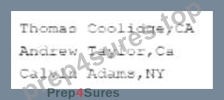
All outputs map only the Name column from row1, but CA employs a filter expression, CA.equals(row1.state), while Ny employs a filter expression, NY. Equals(row1,State). All Rejects have no such configuration.
Under these conditions, how does data flow to the outputs?
- A. CA:Thomas Coodge;Calvin Adams; rejects:Andrew Taylor
- B. CA:Thomas Coolidge Andrew TyalorlNY;Calvin Adams;rejects;none
- C. CA:Thomas Coolidge;Ny:Calvin Adams;rejects:Thomas Coolidge, adrew taylor, Calvin Adame
- D. CA:Thomas Coolidge, Andrew Taylor;Ny:Calvin Adams; rejects:Thomas Coolidge, Andrew Taylor,Calvin Adams
Answer: A
Explanation:
Explanation
The tMap component allows you to configure multiple outputs for your data transformation and mapping. You can apply filter expressions on each output to filter out the rows that meet certain criteria. For example, if you want to send only the rows that have CA as the state value to one output, you can use CA.equals(row1.state) as the filter expression for that output. The filter expression evaluates to true or false for each row, and only the rows that evaluate to true are sent to the output. In this case, only Thomas Coolidge and Andrew Taylor have CA as their state value, so they are sent to the CA output. Similarly, only Calvin Adams has NY as his state value, so he is sent to the NY output. The Rejects output has no filter expression, so it receives all the rows from the input by default. However, since there is a conflict between the CA and NY outputs and the Rejects output, only the rows that are not sent to any other output are sent to the Rejects output. In this case, there are no such rows, so the Rejects output receives no data. References: Talend Open Studio: Open-source ETL and Free Data Integration | Talend,
NEW QUESTION # 41
Where can you simultaneously define primary keys for the Update and Delete operations in a tMysqlOutput component?
- A. Advanced settings view, select the Additional columns options check box
- B. Basic settings view, select the Use field options check box
- C. Advanced settings view, select the Use hint options check box
- D. Advanced settings view, select the Use field options check box
Answer: D
Explanation:
Explanation
The tMysqlOutput component is used to write data into a MySQL database table. The Update and Delete operations are used to modify or remove existing rows in the table based on a primary key. To define the primary key for these operations, you need to use the Use field options check box in the Advanced settings view of the component. This will enable you to specify which columns are used as keys for each operation.
You can also define other options for each column, such as nullable, length, precision, etc. The Use field options check box is not available in the Basic settings view of the component. The Additional columns options check box and the Use hint options check box are used for other purposes, such as adding extra columns or hints to the SQL query, and they do not affect the primary key definition. References: Talend Open Studio: Open-source ETL and Free Data Integration | Talend, [tMysqlOutput properties - 7.3]
NEW QUESTION # 42
Which parameters are defined in File Delimited metadata?
Choose? answers
- A. Component with which the metadata is associated
- B. Position of the fields
- C. File Path
- D. ROW Separator
Answer: C,D
Explanation:
Explanation
The parameters that are defined in File Delimited metadata are:
Row separator: This parameter defines the character or string that separates each row of data in a delimited file. For example, a row separator can be a newline character (\n), a carriage return (\r), or a combination of both (\r\n).
File path: This parameter defines the location and name of the delimited file that you want to read or write. You can browse your local system or enter a URL to specify the file path. You can also use context variables or global variables to make the file path dynamic.
NEW QUESTION # 43
You have two branches: Branch1 contains Job1, and Branch 2 contains Job 2. You want to copy Job1 to Branch 2 and preserve the change history when connecting Studio to Talend Administrator Center.
Which method should you use to preserve the change history?
- A. Switch to Branch 1, right-click Job 1, select Copy to branch, and select Branch 2.
- B. Switch to Branch1, copy lob 1, switch to Branch 2, and paste Job 1 over Job 2.
- C. Switch to Branch 1, copy the Branch 1 job, switch to Branch 2, and paste the job into Branch 2.
- D. Switch to branch 1, copy the Branch 1 Job, switch to Branch 2, and paste the Job into Branch 2.
Answer: A
Explanation:
Explanation
To copy Job1 from Branch1 to Branch2 and preserve the change history when connecting Studio to Talend Administration Center, you need to use the Copy to branchoption. This option allows you to copy a job or a folder from one branch to another branch in the same project without losing the version history. You can access this option by switching to Branch1, right-clicking on Job1 in the Repository tree view, and selecting Copy to branch. This will open a dialog box where you can select Branch2 as the target branch and confirm the copy operation.
You do not need to use the import items, create standard job, or paste over options. These options are not used to copy jobs between branches and preserve the change history. The import items option is used to import items (such as jobs, metadata, routines, etc.) from an archive file that can be exported from another project or workspace. The create standard job option is used to create a new job with a name and a description. The paste over option is used to overwrite an existing job with another job that has been copied or cut from the same or another project. References: Talend Open Studio: Open-source ETL and Free Data Integration | Talend, [Copy to branch - 7.3]
NEW QUESTION # 44
Which Action on table operations are supported by a tMysqlOutput component?
Choose 3 answers
- A. Replace
- B. Drop table
- C. Create table if does not exists
- D. Create table
- E. Drop table if exists andcreate
Answer: C,D,E
Explanation:
Explanation
The tMysqlOutput component is used to write data into a MySQL database table. The Action on table parameter of this component allows you to specify what operation to perform on the table before loading data into it. The Action on table parameter supports the following operations:
Drop table if exists and create: This operation drops the table if it already exists in the database and creates a new one with the same name and structure as defined in the schema.
Create table: This operation creates a new table in the database with the name and structure as defined in the schema. If a table with the same name already exists, an error will be raised.
Create table if does not exist: This operation creates a new table in the database with the name and structure as defined in the schema only if there is no table with the same name already existing in the database. If a table with the same name already exists, no action will be taken.
The Action on table parameter does not support the following operations:
Replace: This is not an operation on the table, but on the data. The Replace parameter of the tMysqlOutput component allows you to specify whether to replace existing rows in the table with new rows based on a key attribute or to insert new rows only.
Drop table: This is not an operation on the table, but on the database. The Drop table parameter of the tMysqlConnection component allows you to specify whether to drop the table after closing the connection or not. References: Talend Open Studio: Open-source ETL and Free Data Integration | Talend, [tMysqlOutput properties - 7.3], [tMysqlConnection properties - 7.3]
NEW QUESTION # 45
......
Get Top-Rated Talend Data-Integration-Developer Exam Dumps Now: https://www.prep4sures.top/Data-Integration-Developer-exam-dumps-torrent.html
Pass Your Data-Integration-Developer Dumps Free Latest Talend Practice Tests: https://drive.google.com/open?id=1KGTY2Xv8r7DF85aFOmNYV1aCN4wOnRfm