


1Z0-1072-20 Free Update With 100% Exam Passing Guarantee [2021]
[Aug-2021] Verified Oracle Exam Dumps with 1Z0-1072-20 Exam Study Guide
NEW QUESTION 90
Which two configuration formats does Terraform support? (Choose two.)
- A. YAML
- B. HCL
- C. JSON
- D. XML
Answer: B,C
Explanation:
Explanation
References:
Terraform configuration files can use either of two formats: Terraform domain-specific language (HashiCorp Configuration Language format [HCL]), which is the recommended approach, or JSON format if the files need to be machine-readable.
NEW QUESTION 91
Which five are the required parameters to launch an instance in Oracle Cloud Infrastructure? (Choose five.)
- A. instance shape
- B. image operating system
- C. host name
- D. Availability Domain
- E. Virtual Cloud Network
- F. subnet
- G. private IP address
Answer: A,B,D,E,F
Explanation:
Explanation
References: https://docs.cloud.oracle.com/iaas/Content/Compute/Concepts/computeoverview.htm
NEW QUESTION 92
Your application front end consists of several Oracle Cloud Infrastructure compute instances behind a public load balancer. You have configured the load balancer to perform health checks on these instances.
What will happen if an instance fails to pass the configured health checks?
- A. The load balancer stops sending traffic to that instance.
- B. The instance is replaced automatically by the load balancer.
- C. The instance is terminated automatically by the load balancer.
- D. The instance is taken out of the backend set by the load balancer.
Answer: A
NEW QUESTION 93
A customer has launched a compute Instance in the Virtual Cloud Network (VCN), which has an Internet gateway, a service gateway, a default security lists and a default route table. Customer has opened up Port 22 in the security lists attached to the compute instance subnet, however is still unable to connect to compute instances using ssh.
Which option would remedy this situation?
- A. Modify the route table associated with the VCN subnet in which the instance resides. Add a following route to the route table.
Destination CIDR: 0.0.0.0/0
Target: Internet Gateway (IGW) - B. Modify the security list associated with the VCN subnet in which the instance resides. Add a stateful egress rule to allow icmp traffic in addition to the port 22.
- C. Modify the route table associated with the VCN subnet in which the instance resides. Add a following route to the route table.
Destination CIDR: 0.0.0.0/0
Target: Dynamic Routing Gateway (DRG) - D. Modify the route table associated with the VCN subnet in which the instance resides. Add a following route to the route table.
Destination CIDR: 0.0.0.0/0
Target: Service Gateway (SGW)
Answer: A
Explanation:
Explanation
You create an internet gateway in the context of a specific VCN. In other words, the internet gateway is automatically attached to a VCN. However, you can disable and re-enable the internet gateway at any time.
For traffic to flow between a subnet and an internet gateway, you must create a route rule accordingly in the subnet's route table (for example, destination CIDR = 0.0.0.0/0 and target = internet gateway). If the internet gateway is disabled, that means no traffic will flow to or from the internet even if there's a route rule that enables that traffic.
For the purposes of access control, you must specify the compartment where you want the internet gateway to reside. If you're not sure which compartment to use, put the internet gateway in the same compartment as the cloud network.
NEW QUESTION 94
You deployed an Oracle Cloud Infrastructure (OCI) compute instance (VM.Standard2.16) to run a SQL database. After a few weeks, you need to increase disk performance by using NVMe disks but keeping the same number of CPUs. As a first step, you terminate the instance and preserve the boot volume.
What is the next step?
- A. Create a new instance using a VM.DenseIO2.16 shape using the preserved boot volume and move the SQL Database data to block volume
- B. Create a new instance using a VM.Standard1.16 shape using the preserved boot volume and move the SQL Database data to NVMe disks
- C. Create a new instance using a VM.DenseIO2.8 shape using the preserved boot volume and move the SQL Database data to NVMe disks
- D. Create a new instance using a VM.DenseIO2.16 shape using the preserved boot volume move the SQL Database data to NVMe disks
Answer: D
Explanation:
to Increase disk performance by using NVMe disks you can use Dense IO Shape also as the number of CPUs will not change so we should VM.DenseIO2.16
NEW QUESTION 95
A customer has established an Oracle Cloud Infrastructure (OCI) FastConnect connection to OCI. The virtual circuit is up and routes are being advertised from the customer's end, however the customer is unable to ping from compute instances inside the virtual cloud network (VCN) to servers residing in its on-premises data center.
Which two options on OCI would remedy this situation? (Choose two.)
- A. Modify the security list associated with the VCN subnet in which the instance resides. Add a stateful ingress rule to allow ICMP traffic from anywhere.
- B. Modify the security list associated with the VCN subnet in which the instance resides. Add a stateful egress rule to allow ICMP traffic to the customer's on-premises network.
- C. Modify the default VCN route table to add a route back to the customer's on-premises network via the DRG.
- D. Modify the route table associated with the VCN subnet in which the instance resides. Add a route to the customer's on-premises network via the Dynamic Routing Gateway (DRG).
Answer: B,D
NEW QUESTION 96
Which statement is true about Data Guard implementation in Oracle Cloud Infrastructure (OCI) bare metal and virtual machine database systems?
- A. Both database systems must be in the same compartment.
- B. Primary and standby database versions and editions need not be identical.
- C. Database systems need not be the same shape type (e.g., primary database can be a virtual machine, and standby database a bare metal shape, and vice versa).
- D. Primary and standby databases must be in the same OCI region.
Answer: A
Explanation:
Explanation/Reference: https://docs.cloud.oracle.com/en-us/iaas/Content/Database/Tasks/exausingdataguard.htm
NEW QUESTION 97
Your company has decided to move a few applications to Oracle Cloud Infrastructure (OCI) and you have been asked to design a cloud-based disaster recovery (DR) solution. One of the requirements is to deploy the DR resources at least 300 miles from the home OCI region and minimize the network latency.
What will be the recommended deployment?
- A. Deploy production and DR applications in the same VCN. Create production subnets in one AD, and DR subnets in another AD.
- B. Deploy production and DR applications in two separate virtual cloud networks (VCNs), each in different regions, and then use VCN local peering gateways for connectivity.
- C. Deploy production and DR applications in two separate VCNs in different availability domains (ADs) within your home region, and then use a VCN remote peering connection for connectivity.
- D. Deploy production and DR applications in two separate VCNs, each in different regions. Connect them using a VCN remote peering connection.
Answer: D
Explanation:
Explanation
Remote VCN peering is the process of connecting two VCNs in different regions The peering allows the VCNs' resources to communicate using private IP addresses without routing the traffic over the internet or through your on-premises network.
NEW QUESTION 98
Your company uses the Oracle Cloud Infrastructure (OCI) Object Storage service to share large data sets with its data science team. The data science team consists of 20 people who work from offices in Washington, D.C., and Tokyo. While working in these offices, employees are assigned an IP address from the public IP range 129.146.31.0/27 Which two steps should you take to ensure that the Object Storage bucket used in this scenario was only accessible from these office locations? (Choose two.)
- A. Set the bucket visibility to public and only share the URL with the data science team via email
- B. Write an IAM policy that includes the conditional statement where request.networkSource.name =CorpNet
- C. Write an IAM policy that includes the conditional statement where request.region =
129.146.31.0/27 - D. Create a pre-authenticated request for each data set and only share with the data science team via email
- E. Create a Network Source named CorpNetwork with a CIDR block of 129.146.31.0/27
- F. Create a Network Source named CorpNetwork with a CIDR block of 129.146.0.0/16
Answer: D,F
NEW QUESTION 99
You have an application server that needs to copy data on Oracle Cloud Infrastrucutre (OCI) object storage in the same region. You have created a service gateway for OCI object storage in your virtual cloud network (VCN) and modified security lists associated with the subnet to allow traffic to the service gateway. You are able to connect to the OCI object storage, however, you notice that the connectivity is over the Internet instead of the service gateway.
What is the reason for this behavior?
- A. The service gateway created in the VCN resides in a different availability domain
- B. The security list associated with the subnet has an egress rule that allows all traffic to be forwarded to a destination CIDR 0.0.0.0/0
- C. Identity and Access Management (IAM) policies restrict the access to the object storage bucket
- D. The route table associated with the subnet has no route rule where the destination is object storage service
Answer: D
NEW QUESTION 100
You have been notified of an application failure indicating that one or more of the Oracle Cloud Infrastructure (OCI) resources have become unavailable. After scanning the Compute and Database consoles, you notice that one of the DB Systems is missing.
What would you do to identify the reason for this missing resource?
- A. Navigate to the Audit console and search the previous 24 hours for all Delete actions to get a list of any resource that was deleted in the past 24 hours.
- B. View the service limits associated with your account to ensure that you have not exceeded the available number of DB system in your tenancy.
- C. Navigate to the Audit console and search the previous 24 hours for all List actions to get a list of every event that occurred in the past 24 hours.
- D. Create a serial console connection to the DB System that does not appear in the management console.
Connect to the serial console connection, and then review the system logs under /var/log/messages.
Answer: A
Explanation:
Explanation
You can filter results by request actions to zero in on only the events with operations that interest you. For example, say that you only want to know about instances that were deleted during a specific time frame. Select a delete request action filter to see only the events with delete operations
NEW QUESTION 101
You have an AI/ML application running on Oracle Cloud Infrastructure. You identified that the application needs GPU and at least 20Gbps Network throughput.
The application is currently using a VM.Standard2.1 compute without any block storage attached to it.
Which two options allow you to get your required performance for your application? (Choose two.)
- A. Terminate the compute instance preserving the boot volume. Create a new compute instance using the VM.Standard2.2 shape using the boot volume preserved, but no block volume attached.
- B. Terminate the compute instance preserving the boot volume. Create a new compute instance using the BM.GPU2.2 shape using the boot volume preserved, but no block volume attached.
- C. Terminate the compute instance preserving the boot volume. Create a new compute instance using the BM.GPU2.2 shape using the boot volume preserved and attach a new block volume to host your application.
- D. Terminate the compute instance preserving the boot volume. Create a new compute instance using the VM.GPU3.4 shape using the boot volume preserved and use the NVMe devices to host your application.
- E. Terminate the compute instance preserving the boot volume. Create a new compute instance using the BM.HPC2.36 shape using the boot volume preserved and use the NVMe devices to host your application.
Answer: C,E
NEW QUESTION 102
You have successfully configured identity federation between Oracle Cloud Infrastructure (OCI) and Oracle Identity Cloud Services (IDCS). A new project manager wants access to OCI for her team and provides the name of an existing group within IDCS to use when granting access.
How do you configure federation to allow the project team access to OCI resources?
- A. Create a new IAM group in OCI and map it to the existing IDCS group. Create a new policy in IDCS and reference the name of the IAM group.
- B. Create a new Identity and Access Management (IAM) policy in OCI and reference the name of the IDCS group in each policy statement.
- C. Create a new IAM group in OCI and map it to the existing IDCS group. Create a new IAM policy and reference the name of the IAM group in each policy statement.
- D. Create a new compartment in OCI with the same name as the existing IDCS group. Create an IAM policy that references the new compartment and the name of the IDCS group.
Answer: C
Explanation:
When working with your IdP, your administrator defines groups and assigns each user to one or more groups according to the type of access the user needs. Oracle Cloud Infrastructure also uses the concept of groups (in conjunction with IAM policies) to define the type of access a user has. As part of setting up the relationship with the IdP, your administrator can map each IdP group to a similarly defined IAM group, so that your company can re-use the IdP group definitions when authorizing user access to Oracle Cloud Infrastructure resources. Here's a screenshot from the mapping process: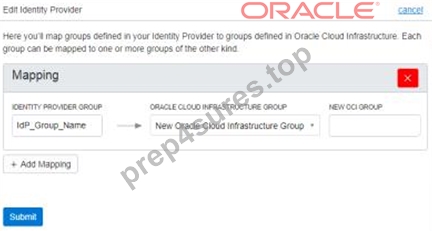
NEW QUESTION 103
Your company is developing a new database application in Oracle Cloud Infrastructure. You need to test application functionality including a hardware failure scenario. Since the application is still in the development phase, you want to minimize infrastructure costs.
Which database service deployment option meets this requirement?
- A. Autonomous Data Warehouse (ADW) system as it provides auto fail over functionality
- B. single node bare metal system
- C. two node bare metal system with data guard enabled
- D. two node real application cluster (RAC) system
Answer: D
NEW QUESTION 104
At the end of a terraform apply operation, what is the default output?
- A. nothing by default
- B. statistics about what was added, changed, and destroyed, and the values of outputs
- C. the entire state file
- D. statistics about what was added, changed, and destroyed
Answer: B
NEW QUESTION 105
Which two statements are true regarding cloning a block volume?
- A. You can change the block volume size when creating a clone
- B. You can clone block volumes across regions
- C. You can skip block volume encryption when creating a clone
- D. You can change the block volume performance when creating a clone
Answer: A,D
Explanation:
Explanation
You can create a clone from a volume using the Block Volume service. Cloning enables you to make a copy of an existing block volume without needing to go through the backup and restore process.
A cloned volume is a point-in-time direct disk-to-disk deep copy of the source volume, so all the data that is in the source volume when the clone is created is copied to the clone volume.
You can only create a clone for a volume within the same region, availability domain and tenant. You can create a clone for a volume between compartments as long as you have the required access permissions for the operation.
during create a clone you can do the following
If you want to clone the block volume to a larger size volume, check Custom Block Volume Size (GB) and then specify the new size. You can only increase the size of the volume, you cannot decrease the size. If you clone the block volume to a larger size volume, you need to extend the volume's partition. See Extending the Partition for a Block Volume for more information.
If you want to change the elastic performance setting when cloning the volume, check Custom Block Volume Performance and select the elastic performance setting you want the volume clone to use. See Block Volume Elastic Performance for more information. You can also change the elastic performance setting after you have cloned the volume, see Block Volume Elastic Performance. If you leave Custom Block Volume Performance unchecked, the cloned volume will use the same elastic performance setting as the source volume.
NEW QUESTION 106
......
Authentic Best resources for 1Z0-1072-20 Online Practice Exam: https://www.prep4sures.top/1Z0-1072-20-exam-dumps-torrent.html