


[Sep-2021] DP-900 Dumps Full Questions - Microsoft Certified: Azure Data Fundamentals Exam Study Guide
Exam Questions and Answers for DP-900 Study Guide
NEW QUESTION 53
For each of the following statements, select Yes if the statement is true. Otherwise, select No.
NOTE: Each correct selection is worth one point.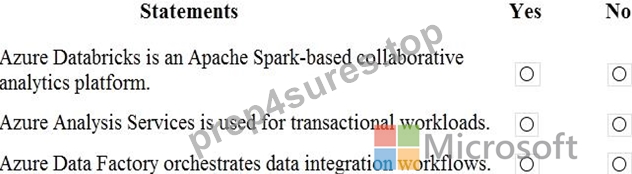
Answer:
Explanation: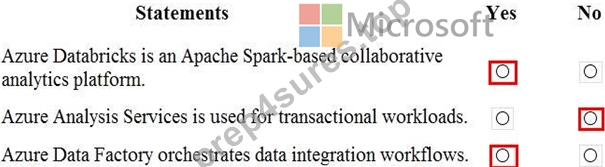
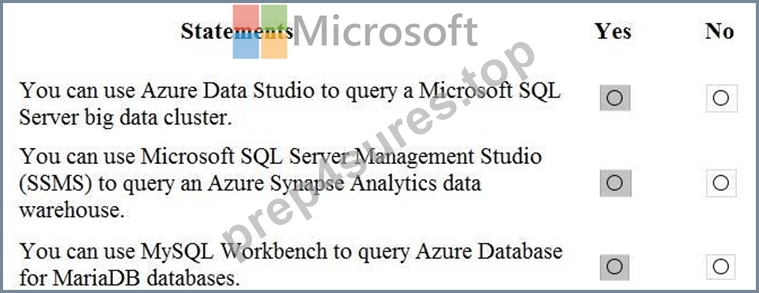
NEW QUESTION 54
For each of the following statements, select Yes if the statement is true. Otherwise, select No.
NOTE: Each correct selection is worth one point.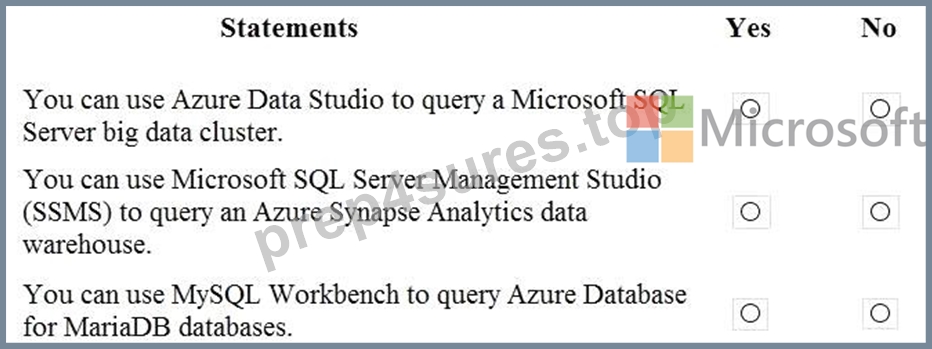
Answer:
Explanation: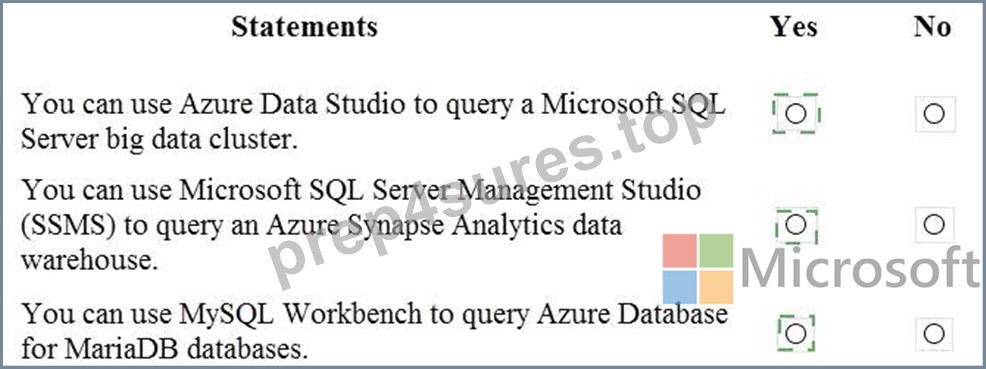
NEW QUESTION 55
Match the types of data to the appropriate Azure data services.
To answer, drag the appropriate data types from the column on the left to its service on the right. Each data type may be used once, more than once, or not at all.
NOTE: Each correct match is worth one point.
Answer:
Explanation:
Reference:
https://docs.microsoft.com/en-us/azure/storage/tables/table-storage-design-modeling
NEW QUESTION 56
To complete the sentence select the appropriate option in the answer area.
Answer:
Explanation:

NEW QUESTION 57
What are two characteristics of real-time data processing? Each correct answer present a complete solution.
NOTE: Each correct selection is worth one point.
- A. Data is processed periodically
- B. Low latency is expected
- C. High latency acceptable
- D. Data is processed as it is created.
Answer: A,B
NEW QUESTION 58
Your company is designing a data store that will contain student data. The data has the following format.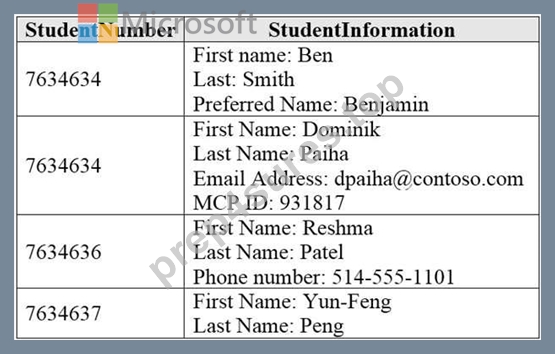
Which type of data store should you use?
- A. key/value
- B. graph
- C. columnar
- D. object
Answer: C
Explanation:
Section: Describe how to work with non-relational data on Azure
Explanation/Reference:
NEW QUESTION 59
You have an application that runs on Windows and requires access to a mapped drive.
Which Azure service should you use?
- A. Azure Blob storage
- B. Azure Files
- C. Azure Cosmos DB
- D. Azure Table storage
Answer: B
Explanation:
Azure Files is Microsoft's easy-to-use cloud file system. Azure file shares can be seamlessly used in Windows and Windows Server.
To use an Azure file share with Windows, you must either mount it, which means assigning it a drive letter or mount point path, or access it via its UNC path.
Reference:
https://docs.microsoft.com/en-us/azure/storage/files/storage-how-to-use-files-windows
NEW QUESTION 60
You need to use Transact-SQL to query files in Azure Data Lake Storage from an Azure Synapse Analytics data warehouse.
What should you use to query the files?
- A. PolyBase
- B. Microsoft SQL Server Integration Services (SSIS)
- C. Azure Data Factory
- D. Azure Functions
Answer: A
Explanation:
Section: Describe an analytics workload on Azure
Explanation/Reference:
https://docs.databricks.com/data/data-sources/azure/synapse-analytics.html
NEW QUESTION 61
To complete the sentence, select the appropriate option in the answer area.
Answer:
Explanation:
NEW QUESTION 62
For each of the following statements, select Yes if the statement is true. Otherwise, select No.
NOTE: Each correct selection is worth one point.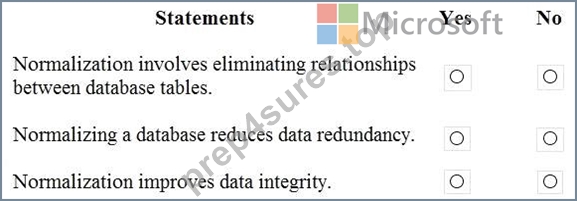
Answer:
Explanation: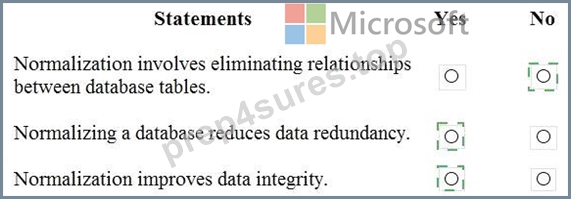
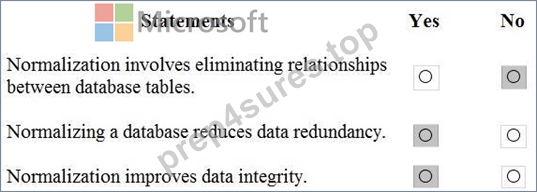
NEW QUESTION 63
For each of the following statements, select yes if he statement is true, Otherwise select No.
NOTE: Each correct selection is worth one point.
Answer:
Explanation:
NEW QUESTION 64
You have a transactional application that stem data in an Azure SQL managed instance. When should you implement a read-only database replica?
- A. You need to improve the recovery point objective (RPO).
- B. You need to implement high availability in the event of a regional outage
- C. You need to audit the transactional application.
- D. You need to generate reports without affecting the transactional workload.
Answer: D
Explanation:
Use read-only replicas to offload read-only query workloads.
Reference:
https://docs.microsoft.com/en-us/azure/azure-sql/database/read-scale-out
NEW QUESTION 65
For each of the following statements, select yes if the statement is true, Otherwise, select No.
Note: Each correct selection is worth one point.
Answer:
Explanation:

NEW QUESTION 66
You have a SQL query that combines customer data and order data. The query includes calculated columns.
You need to persist the SQL query so that other users can use the query.
What should you create?
- A. an index
- B. a view
- C. a table
- D. a scalar function
Answer: B
Explanation:
Section: Describe core data concepts
Explanation:
A view is a virtual table whose contents are defined by a query. A view acts as a filter on the underlying tables referenced in the view. The query that defines the view can be from one or more tables or from other views in the current or other databases.
Reference:
https://docs.microsoft.com/en-us/sql/relational-databases/views/views
NEW QUESTION 67
Match the Azure services to the appropriate requirements.
To answer, drag the appropriate service from the column on the left to its requirement on the right. Each service may be used once, more than once, or not at all.
NOTE: Each correct match is worth one point.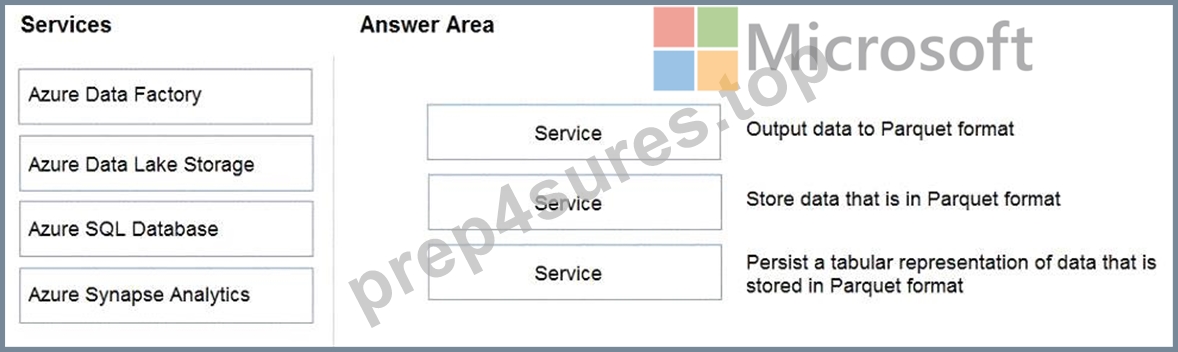
Answer:
Explanation: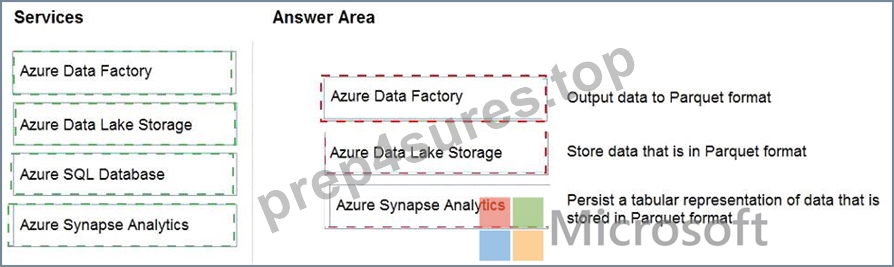
Explanation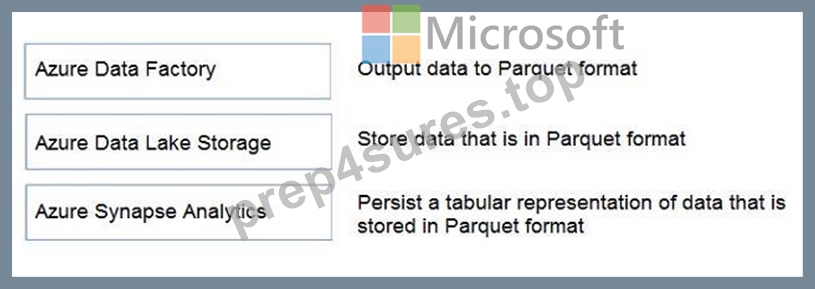
Box 1: Azure Data Factory
Box 2: Azure Data Lake Storage
Azure Data Lake Storage (ADLA) now natively supports Parquet files. ADLA adds a public preview of the native extractor and outputter for the popular Parquet file format Box 3: Azure Synapse Analytics Use Azure Synapse Analytics Workspaces.
NEW QUESTION 68
HOTSPOT
For each of the following statements, select Yes if the statement is true. Otherwise, select No.
NOTE: Each correct selection is worth one point.
Hot Area: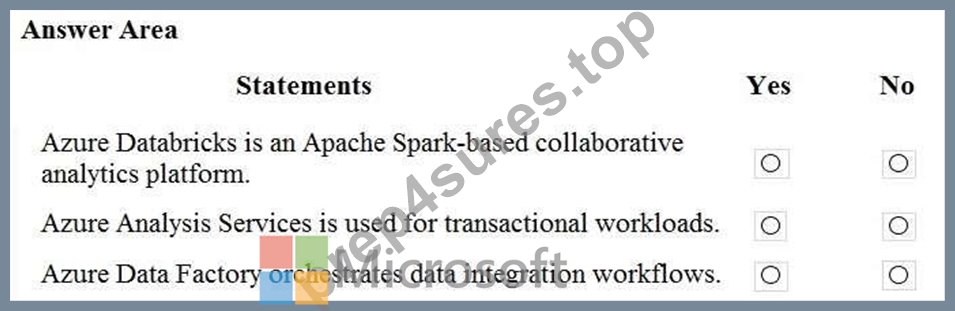
Answer:
Explanation: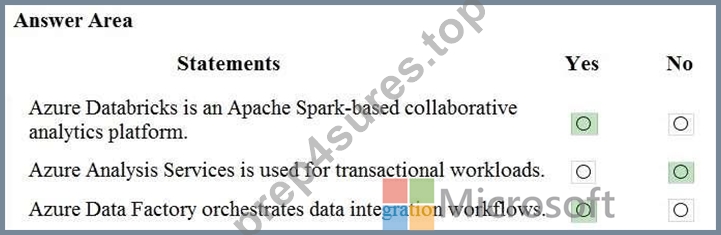
Section: Describe an analytics workload on Azure
Explanation/Reference:
https://docs.microsoft.com/en-us/azure/databricks/scenarios/what-is-azure-databricks
https://docs.microsoft.com/en-us/azure/analysis-services/analysis-services-overview
https://docs.microsoft.com/en-us/azure/data-factory/introduction
NEW QUESTION 69
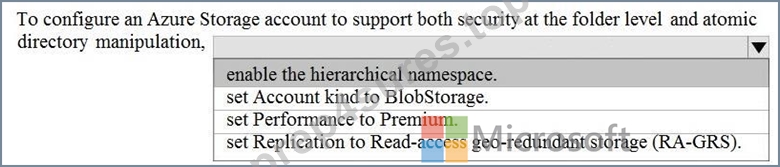
To complete the sentence, select the appropriate option in the answer area.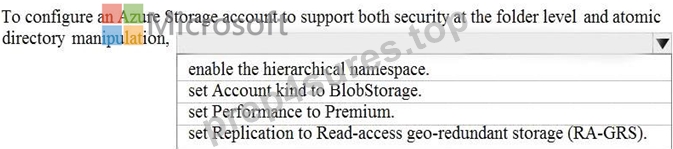
Answer:
Explanation: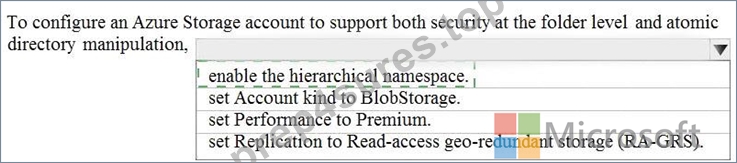
NEW QUESTION 70
Your company plans to load data from a customer relationship management (CRM) system to a data warehouse by using an extract load, and transform (ELT) process.
Where does data processing occur for each stage of the ELT process? To answer, drag the appropriate locations to the correct. Each location may be used once, or not at all, You may need to drag the split bar between panes or scroll to view content.
NOTE: Each correct selection is worth one point.
Answer:
Explanation:
Explanation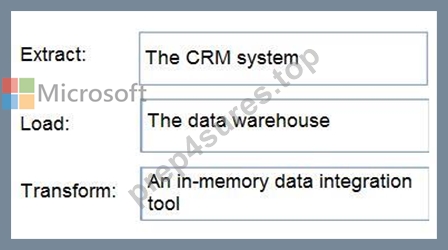
Box 1: The CRM system
Data is extracted from the CRM system.
Box 2: The data warehouse
Data is loaded to the data warehouse.
Box 3: An in-memory data integration tool
The data transformation that takes place usually involves various operations, such as filtering, sorting, aggregating, joining data, cleaning data, deduplicating, and validating data.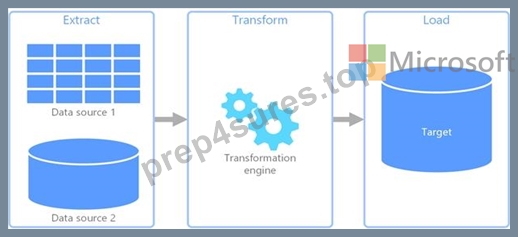
NEW QUESTION 71
You have an Azure Cosmos DB account that uses the Core (SQL) API.
Which two settings can you configure at the container level? Each correct answer presents a complete solution. (Choose two.) NOTE: Each correct selection is worth one point.
- A. the API
- B. the read region
- C. the throughput
- D. the partition key
Answer: C,D
NEW QUESTION 72
Which command-line tool can you use to query Azure SQL databases?
- A. Azure CLI
- B. bcp
- C. azdata
- D. sqlcmd
Answer: D
Explanation:
Reference:
https://docs.microsoft.com/en-us/azure/azure-sql/database/az-cli-script-samples-content-guide?tabs=singledatabase
NEW QUESTION 73
Your company is designing a data store for internet-connected temperature sensors.
The collected data will be used to analyze temperature trends.
Which type of data store should you use?
- A. columnar
- B. relational
- C. graph
- D. time series
Answer: D
Explanation:
Section: Describe how to work with non-relational data on Azure
Explanation:
Time series data is a set of values organized by time. Time series databases typically collect large amounts of data in real time from a large number of sources. Updates are rare, and deletes are often done as bulk operations. Although the records written to a time-series database are generally small, there are often a large number of records, and total data size can grow rapidly.
Reference:
https://docs.microsoft.com/en-us/azure/architecture/guide/technology-choices/data-store-overview
NEW QUESTION 74
To complete the sentence, select the appropriate option in the answer area.
Answer:
Explanation:

NEW QUESTION 75
Your company needs to ensure that in Azure virtual machine can connect to Azure SQL databases without exposing the databases to the internet. What should you use?
- A. Azure DNS
- B. Azure Application Gateway
- C. Azure Traffic Manager
- D. Azure Private link
Answer: B
NEW QUESTION 76
To complement the sentence, select the appropriate option in the answer area.
Answer:
Explanation:
NEW QUESTION 77
......
Microsoft Azure Data Fundamentals Free Update With 100% Exam Passing Guarantee: https://www.prep4sures.top/DP-900-exam-dumps-torrent.html
Real Exam Questions & Answers - Microsoft DP-900 Dump is Ready: https://drive.google.com/open?id=1eRs5Luw9sl115_CF7QF1ISF-sc3TCO6z