


[Jan-2022] AZ-104 Dumps are Available for Instant Access using Prep4sures
AZ-104 Dumps 2022 - New Microsoft AZ-104 Exam Questions
Module 4: Virtual Networking Configuration and Management
A large part of the exam content is based on virtual networking. With the help of various sub-topics, this section tries to educate the applicant on the key concepts like various network interfaces, private DNS zone configuration, private IP addresses, VNET peering, and setup for Azure DNS. An extensive understanding of the load balancer configuration, Azure troubleshooting, the integration of on-premises networks with virtual ones, and the principles of secure access should also be gained in this domain.
NEW QUESTION 268
You have an Azure Kubernetes Service (AKS) cluster named AKS1 and a computer named Computer1 that runs Windows 10. Computer1 that has the Azure CLI installed.
You need to install the kubectl client on Computer1.
Which command should you run? To answer, select the appropriate options in the answer area.
NOTE: Each correct selection is worth one point.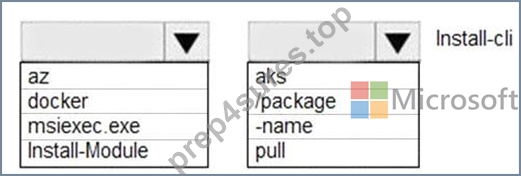
Answer:
Explanation: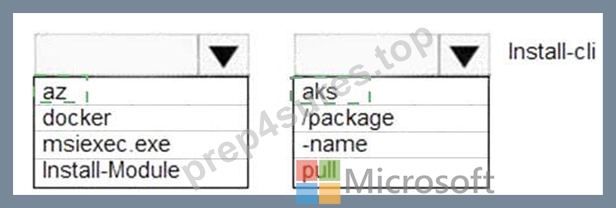
Explanation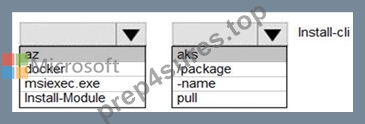
To install kubectl locally, use the az aks install-cli command:
az aks install-cli
Reference:
https://docs.microsoft.com/en-us/azure/aks/kubernetes-walkthrough
NEW QUESTION 269
You have an Azure subscription that contains a storage account.
You have an on-premises server named Server1 that runs Window Server 2016. Server1 has 2 TB of data.
You need to transfer the data to the storage account by using the Azure Import/Export service.
In which order should you perform the actions? To answer, move all actions from the list of actions to the answer area and arrange them in the correct order.
NOTE: More than one order of answer choices is correct. You will receive credit for any of the correct orders you select.
Answer:
Explanation:
Explanation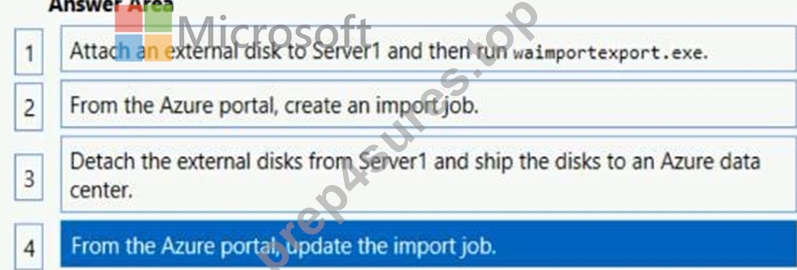
At a high level, an import job involves the following steps:
Step 1: Attach an external disk to Server1 and then run waimportexport.exe Determine data to be imported, number of drives you need, destination blob location for your data in Azure storage.
Use the WAImportExport tool to copy data to disk drives. Encrypt the disk drives with BitLocker.
Step 2: From the Azure portal, create an import job.
Create an import job in your target storage account in Azure portal. Upload the drive journal files.
Step 3: Detach the external disks from Server1 and ship the disks to an Azure data center.
Provide the return address and carrier account number for shipping the drives back to you.
Ship the disk drives to the shipping address provided during job creation.
Step 4: From the Azure portal, update the import job
Update the delivery tracking number in the import job details and submit the import job.
The drives are received and processed at the Azure data center.
The drives are shipped using your carrier account to the return address provided in the import job.
References:
https://docs.microsoft.com/en-us/azure/storage/common/storage-import-export-service
NEW QUESTION 270
You have an Azure subscription named Subscription1 that contains the resources in the following table.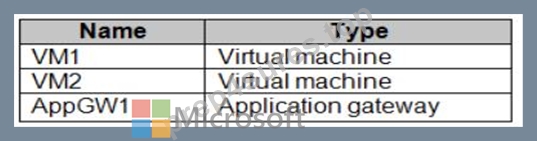
VM1 and VM2 run the websites in the following table.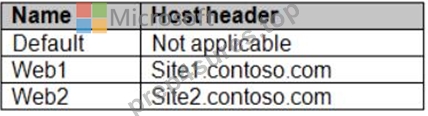
AppGW1 has the backend pools in the following table.
DNS resolves site1.contoso.com, site2.contoso.com, and site3.contoso.com to the IP address of AppGW1.
AppGW1 has the listeners in the following table.
AppGW1 has the rules in the following table.
For each of the following statements, select Yes if the statement is true. Otherwise, select No.
NOTE: Each correct selection is worth one point.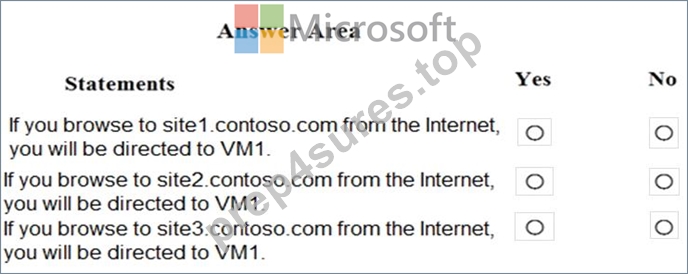
Answer:
Explanation: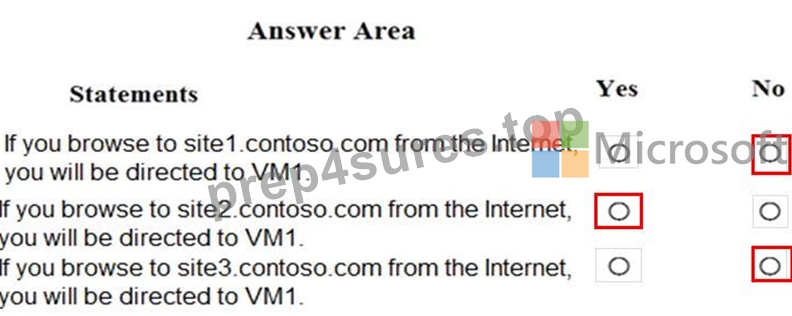
Explanation:
Vm1 is in Pool1. Rule2 applies to Pool1, Listener 2, and site2.contoso.com
NEW QUESTION 271
You have an Azure subscription.
You enable multi-factor authentication for all users.
Some users report that the email applications on their mobile device cannot connect to their Microsoft Exchange Online mailbox. The users can access Exchange Online by using a web browser and from Microsoft Outlook 2016 on their computer.
You need to ensure that the users can use the email applications on their mobile device.
What should you instruct the users to do?
- A. Enable self-service password reset
- B. Reinstall the Microsoft Authenticator app
- C. Create an app password
- D. Reset the Azure Active Directory (Azure AD) password
Answer: C
Explanation:
Explanation
If you're enabled for multi-factor authentication, make sure that you have set up app passwords.
Note: During your initial two-factor verification registration process, you're provided with a single app password. If you require more than one, you'll have to create them yourself.
Go to the Additional security verification page.
References:
https://docs.microsoft.com/en-us/office365/troubleshoot/sign-in/sign-in-to-office-365-azure-intune
https://docs.microsoft.com/sv-se/azure/active-directory/user-help/multi-factor-authentication-end-user-app-passw
NEW QUESTION 272
You have Azure subscription that includes following Azure file shares: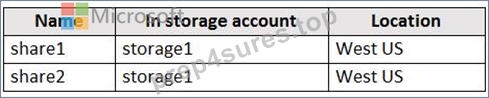
You have the following on-premises servers: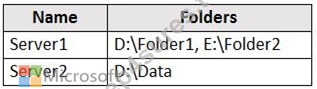
You create a Storage Sync Service named Sync1 and an Azure File Sync group named Group1. Group1 uses share1 as a cloud endpoint.
You register Server1 and Server2 in Sync1. You add D:\Folder1 on Server1 as a server endpoint of Group1.
For each of the following statements, select Yes if the statement is true. Otherwise, select No.
NOTE: Each correct selection is worth one point.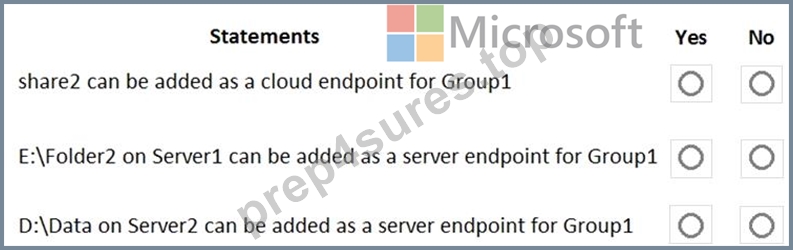
Answer:
Explanation: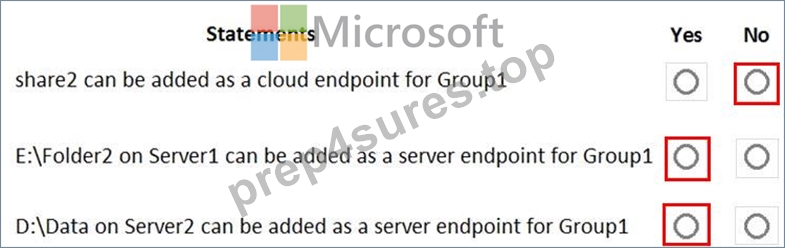
References:
https://docs.microsoft.com/en-us/azure/storage/files/storage-sync-files-deployment-guide
NEW QUESTION 273
You have an Active Directory domain named contoso.com that contains the objects shown in the following table.
The groups have the memberships shown in the following table.
OU1 and OU2 are synced to Azure Active Directory (Azure AD).
You modify the synchronization settings and remove OU1 from synchronization. You sync Active Directory and Azure AD.
Which objects are in Azure AD?
- A. User1, User2, Group1, User4, and Group2 only
- B. User4 and Group2 only
- C. User2, Group1, User4, and Group2 only
- D. User1, User2, User3, User4, Group1, and Group2
Answer: A
NEW QUESTION 274
You have an Azure subscription that contains an Azure Directory (Azure AD) tenant named contoso.com. The tenant is synced to the on-premises Active Directory domain. The domain contains the users shown in the following table.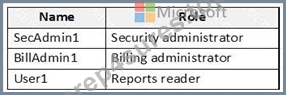
You enable self-service password reset (SSPR) for all users and configure SSPR to have the following authentication methods:
* Number of methods required to reset: 2
* Methods available to users: Mobile phone, Security questions
* Number of questions required to register: 3
* Number of questions required to reset: 3
You select the following security questions:
* What is your favorite food?
* In what city was your first job?
* What was the name of your first pet?
For each of the following statements, select Yes if the statement is true. Otherwise, select No.
NOTE: Each correct selection is worth one point.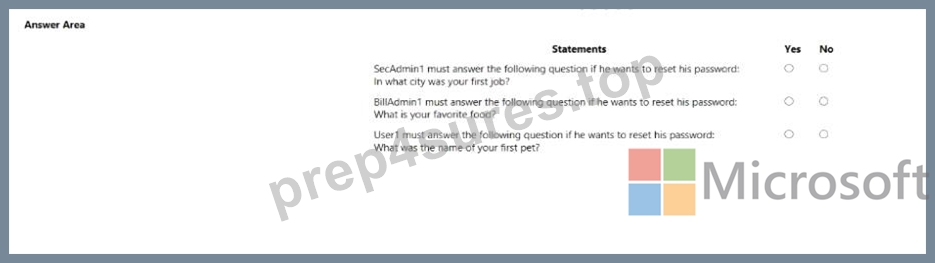
Answer:
Explanation: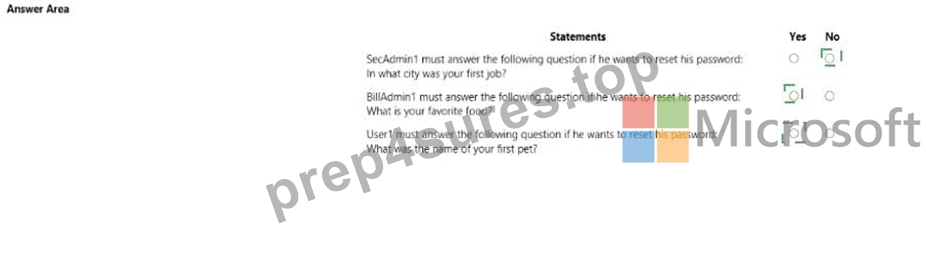
Explanation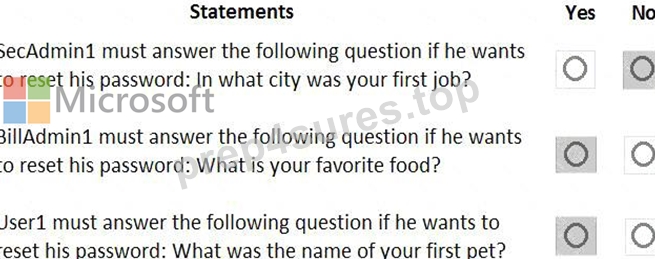
Box 1: No
Administrator accounts are special accounts with elevated permissions. To secure them, the following restrictions apply to changing passwords of administrators:
On-premises enterprise administrators or domain administrators cannot reset their password through Self-service password reset (SSPR). They can only change their password in their on-premises environment.
Thus, we recommend not syncing on-prem AD admin accounts to Azure AD.
An administrator cannot use secret Questions & Answers as a method to reset password.
Box 2: Yes
Self-service password reset (SSPR) is an Azure Active Directory feature that enables employees to reset their passwords without needing to contact IT staff.
Box 3: Yes
References:
https://docs.microsoft.com/en-us/azure/active-directory/authentication/howto-sspr-deployment
NEW QUESTION 275
You need to meet the connection requirements for the New York office.
What should you do? To answer, select the appropriate options in the answer area.
NOTE: Each correct selection is worth one point.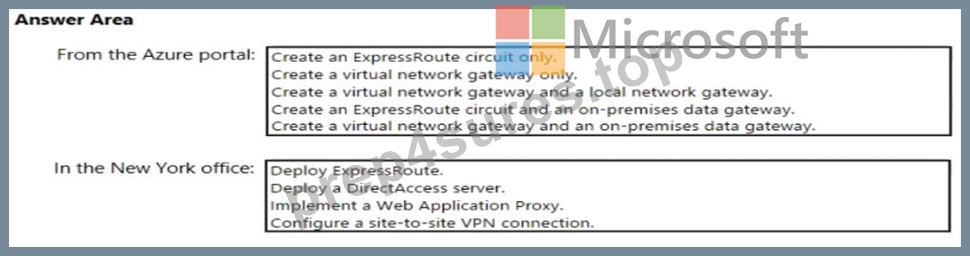
Answer:
Explanation: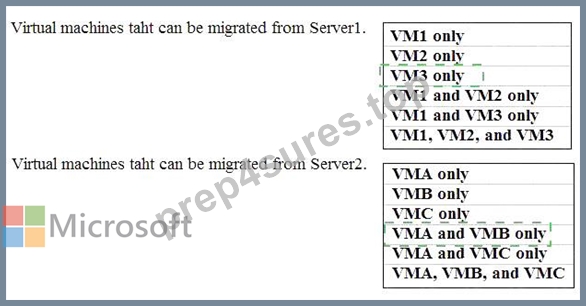
Explanation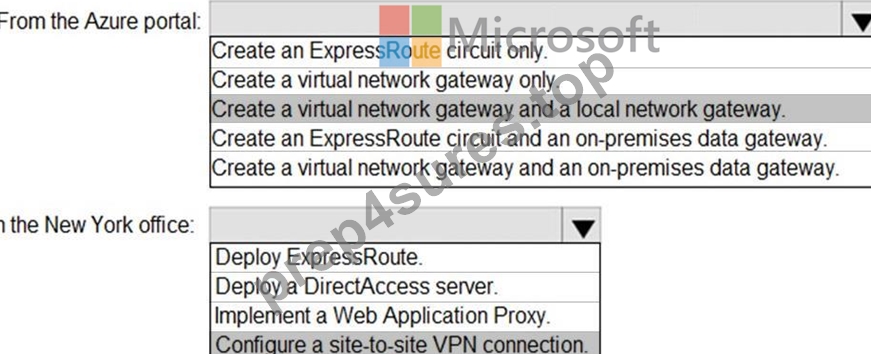
Box 1: Create a virtual network gateway and a local network gateway.
Azure VPN gateway. The VPN gateway service enables you to connect the VNet to the on-premises network through a VPN appliance. For more information, see Connect an on-premises network to a Microsoft Azure virtual network. The VPN gateway includes the following elements:
* Virtual network gateway. A resource that provides a virtual VPN appliance for the VNet. It is
* responsible for routing traffic from the on-premises network to the VNet.
* Local network gateway. An abstraction of the on-premises VPN appliance. Network traffic from the cloud application to the on-premises network is routed through this gateway.
* Connection. The connection has properties that specify the connection type (IPSec) and the key shared with the on-premises VPN appliance to encrypt traffic.
* Gateway subnet. The virtual network gateway is held in its own subnet, which is subject to various requirements, described in the Recommendations section below.
Box 2: Configure a site-to-site VPN connection
On premises create a site-to-site connection for the virtual network gateway and the local network gateway.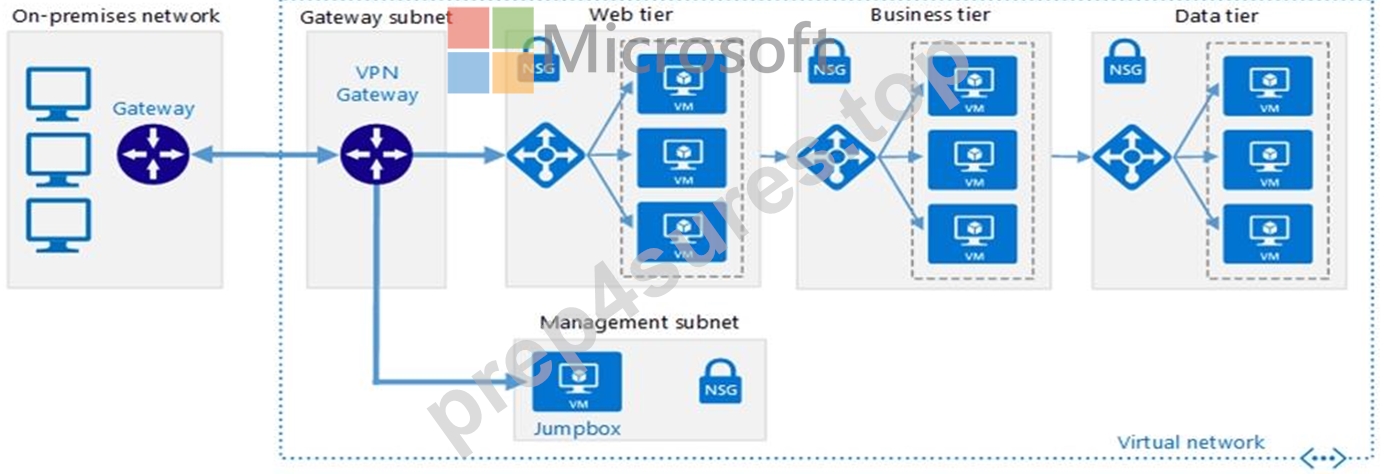
Scenario: Connect the New York office to VNet1 over the Internet by using an encrypted connection.
NEW QUESTION 276
You have an Azure subscription named Subscription1 that contains the resources shown in the following table.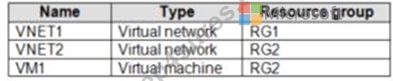
The status of VM1 is Running.
You assign an Azure policy as shown in the exhibit. (Click the Exhibit tab.)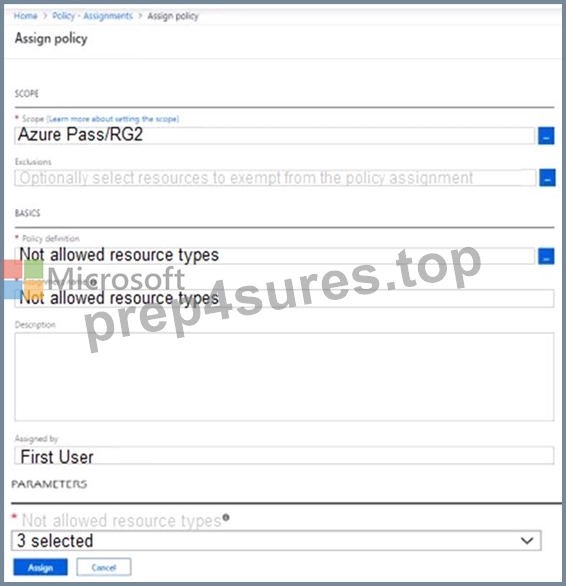
You assign the policy by using the following parameters:
For each of the following statements, select Yes if the statement is true. Otherwise, select No.
NOTE: Each correct selection is worth one point.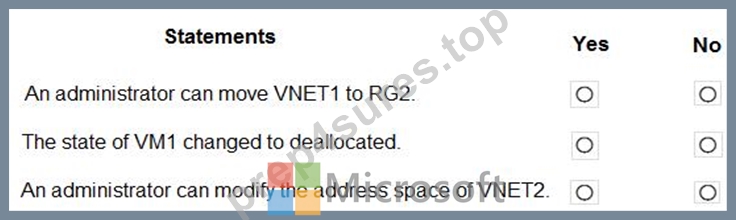
Answer:
Explanation: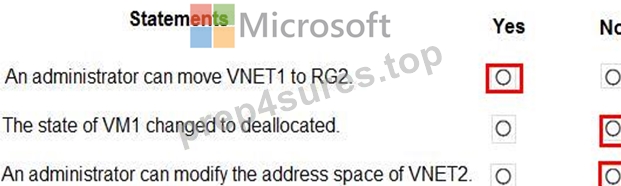
Reference:
https://docs.microsoft.com/en-us/azure/governance/policy/assign-policy-portal
NEW QUESTION 277
You have an Azure subscription that contains the resources shown in the following table.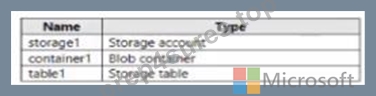
You need to perform the tasks shown in the following table.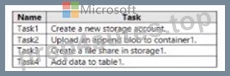
Which tasks can you perform by using Azure Storage Explorer ?
- A. Task2, Task3, and Task4 only
- B. Task1 and Task3 only
- C. Take1,Take2, Take3, and Take4
- D. Task1Task2 and Task3 only
- E. Task1. Task2 and Task3 only
Answer: B
NEW QUESTION 278
Note: This question is part of a series of questions that present the same scenario. Each question in the series contains a unique solution that might meet the stated goals. Some question sets might have more than one correct solution, while others might not have a correct solution.
After you answer a question in this section, you will NOT be able to return to it. As a result, these questions will not appear in the review screen.
You deploy an Azure Kubernetes Service (AKS) cluster named AKS1.
You need to deploy a YAML file to AKS1.
Solution: From Azure Cloud Shell, you run az aks.
Does this meet the goal?
- A. No
- B. Yes
Answer: B
Explanation:
Explanation
Installing Azure CLI doesn't mean that Azure Kubernates client is installed. So before running kubectl client command, you have install kubectl, the Kubernetes command-line client.
First need to run az aks install-cli to install Kubernetes CLI, which is kubectl Reference:
https://docs.microsoft.com/en-us/cli/azure/aks?view=azure-cli-latest
NEW QUESTION 279
You need to prepare the environment to ensure that the web administrators can deploy the web apps as quickly as possible.
Which three actions should you perform in sequence? To answer, move the appropriate actions from the list of actions to the answer area and arrange them in the correct order.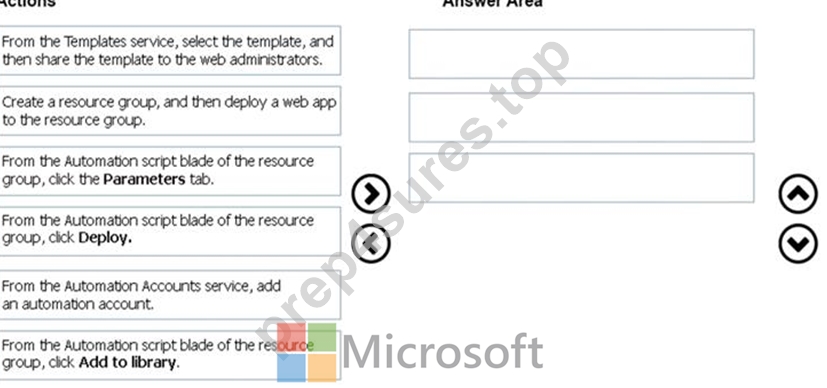
Answer:
Explanation: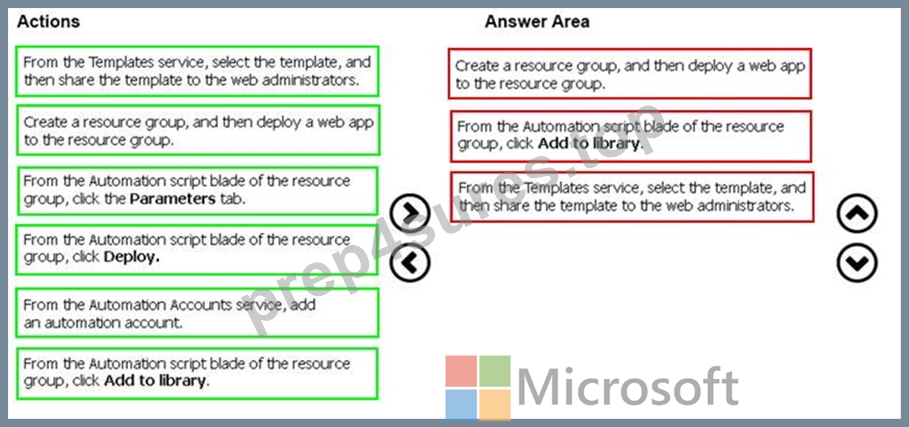
Explanation:
Scenario:
1. Web administrators will deploy Azure web apps for the marketing department.
2. Each web app will be added to a separate resource group.
3. The initial configuration of the web apps will be identical.
4. The web administrators have permission to deploy web apps to resource groups.
Steps:
1 --> Create a resource group, and then deploy a web app to the resource group.
2 --> From the Automation script blade of the resource group , click Add to Library.
3 --> From the Templates service, select the template, and then share the template to the web administrators .
References:
https://docs.microsoft.com/en-us/azure/azure-resource-manager/templates/quickstart-create-templates-use-the-portal
NEW QUESTION 280
You have an Azure subscription that contains a storage account named account1.
You plan to upload the disk files of a virtual machine to account1 from your on-premises network. The on- premises network uses a public IP address space of 131.107.1.0/24.
You plan to use the disk files to provision an Azure virtual machine named VM1. VM1 will be attached to a virtual network named VNet1. VNet1 uses an IP address space of 192.168.0.0/24.
You need to configure account1 to meet the following requirements:
* Ensure that you can upload the disk files to account1.
* Ensure that you can attach the disks to VM1.
* Prevent all other access to account1.
Which two actions should you perform? Each correct answer presents part of the solution.
NOTE: Each correct selection is worth one point.
- A. From the Service endpoints blade of VNet1, add a service endpoint.
- B. From the Firewalls and virtual networks blade of account1, select Allow trusted Microsoft services to access this storage account.
- C. From the Firewalls and virtual networks blade of account1, add VNet1.
- D. From the Firewalls and virtual networks blade of account1, select Selected networks.
- E. From the Firewalls and virtual networks blade of account1, add the 131.107.1.0/24 IP address range.
Answer: A,D
Explanation:
Section: [none]
Explanation:
A: By default, storage accounts accept connections from clients on any network. To limit access to selected networks, you must first change the default action.
Azure portal
1. Navigate to the storage account you want to secure.
2. Click on the settings menu called Firewalls and virtual networks.
3. To deny access by default, choose to allow access from 'Selected networks'. To allow traffic from all networks, choose to allow access from 'All networks'.
4. Click Save to apply your changes.
E: Grant access from a Virtual Network
Storage accounts can be configured to allow access only from specific Azure Virtual Networks.
By enabling a Service Endpoint for Azure Storage within the Virtual Network, traffic is ensured an optimal route to the Azure Storage service. The identities of the virtual network and the subnet are also transmitted with each request.
Reference:
https://docs.microsoft.com/en-us/azure/storage/common/storage-network-security
NEW QUESTION 281
You need to the appropriate sizes for the Azure virtual for Server2.
What should you do? To answer, select the appropriate options in the answer area.
NOTE: Each correct selection is worth one point.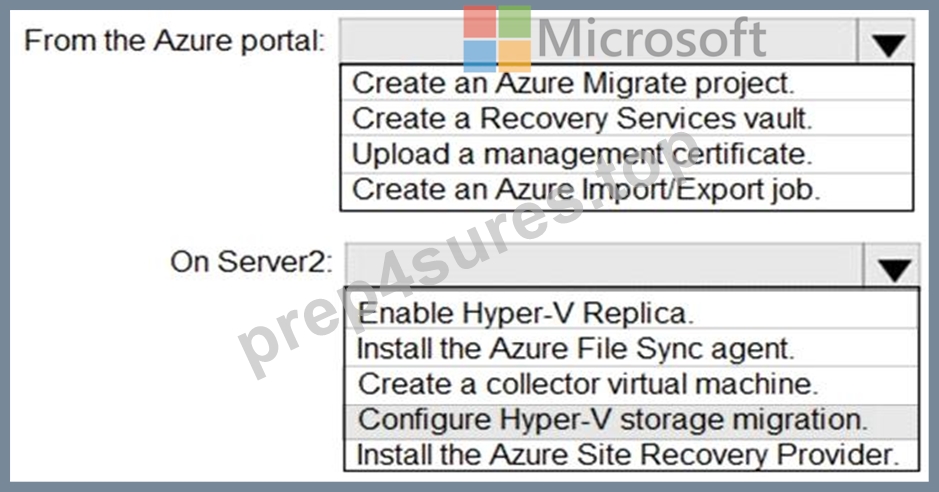
Answer:
Explanation: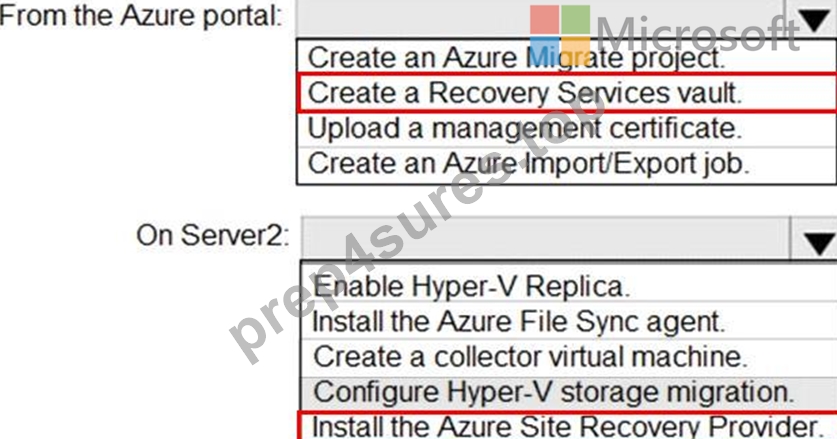
Explanation:
Box 1: Create a Recovery Services vault
Create a Recovery Services vault on the Azure Portal.
Box 2: Install the Azure Site Recovery Provider
Azure Site Recovery can be used to manage migration of on-premises machines to Azure.
Scenario: Migrate the virtual machines hosted on Server1 and Server2 to Azure.
Server2 has the Hyper-V host role.
References:
https://docs.microsoft.com/en-us/azure/site-recovery/migrate-tutorial-on-premises-azure
NEW QUESTION 282
You have an Azure Active Directory (Azure AD) tenant named contosocloud.onmicrosoft.com.
Your company has a public DNS zone for contoso.com.
You add contoso.com as a custom domain name to Azure AD.
You need to ensure that Azure can verify the domain name.
Which type of DNS record should you create?
- A. NSEC3
- B. PTR
- C. MX
- D. RRSIG
Answer: C
Explanation:
TXT or MX : Correct
You can use either a TXT or MX record to verify the custom domain in the Azure AD. MX records can serve the purpose of TXT records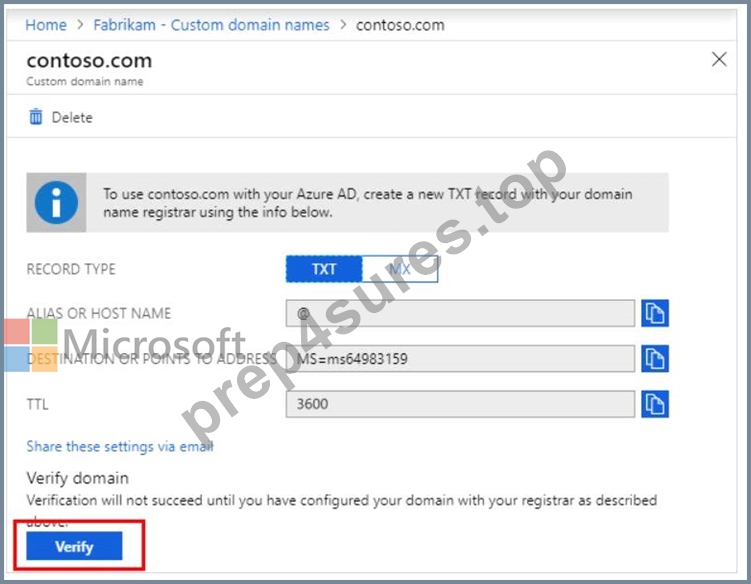
SRV : Incorrect
SRV records are used by various services to specify server locations. When specifying an SRV record in Azure DNS
DNSKEY : Incorrect Choice
This will verify that the records are originating from an authorized sender.
NSEC : Incorrect Choice
This is Part of DNSSEC. This is used for explicit denial-of-existence of a DNS record. It is used to prove a name does not exist.
Reference:
https://docs.microsoft.com/en-us/azure/dns/dns-web-sites-custom-domain
https://docs.microsoft.com/en-us/azure/active-directory/fundamentals/add-custom-domain#verify-your-custom-domain-name
https://www.cloudflare.com/dns/dnssec/how-dnssec-works/#:~:text=DNSKEY%20%2D%20Contains%20a%20public%20signing,s)%20in%20the%20parent%20zone.
NEW QUESTION 283
......
Microsoft AZ-104 Exam Practice Test Questions: https://www.prep4sures.top/AZ-104-exam-dumps-torrent.html
Free AZ-104 Braindumps Download Updated: https://drive.google.com/open?id=1v7VuUnyhFLaKjY6KbA7vV9C2h0Zwg1qy